The Freight of a Human Voice
Leila Darkstar brings a stolen cylinder to a port where everyone has something to sell. The man she hired on Argos has brought something of his own.
Captain’s Log: 2734 — Ashfall Quay
Leila Darkstar brings a stolen cylinder to a port where everyone has something to sell. The man she hired on Argos has brought something of his own.
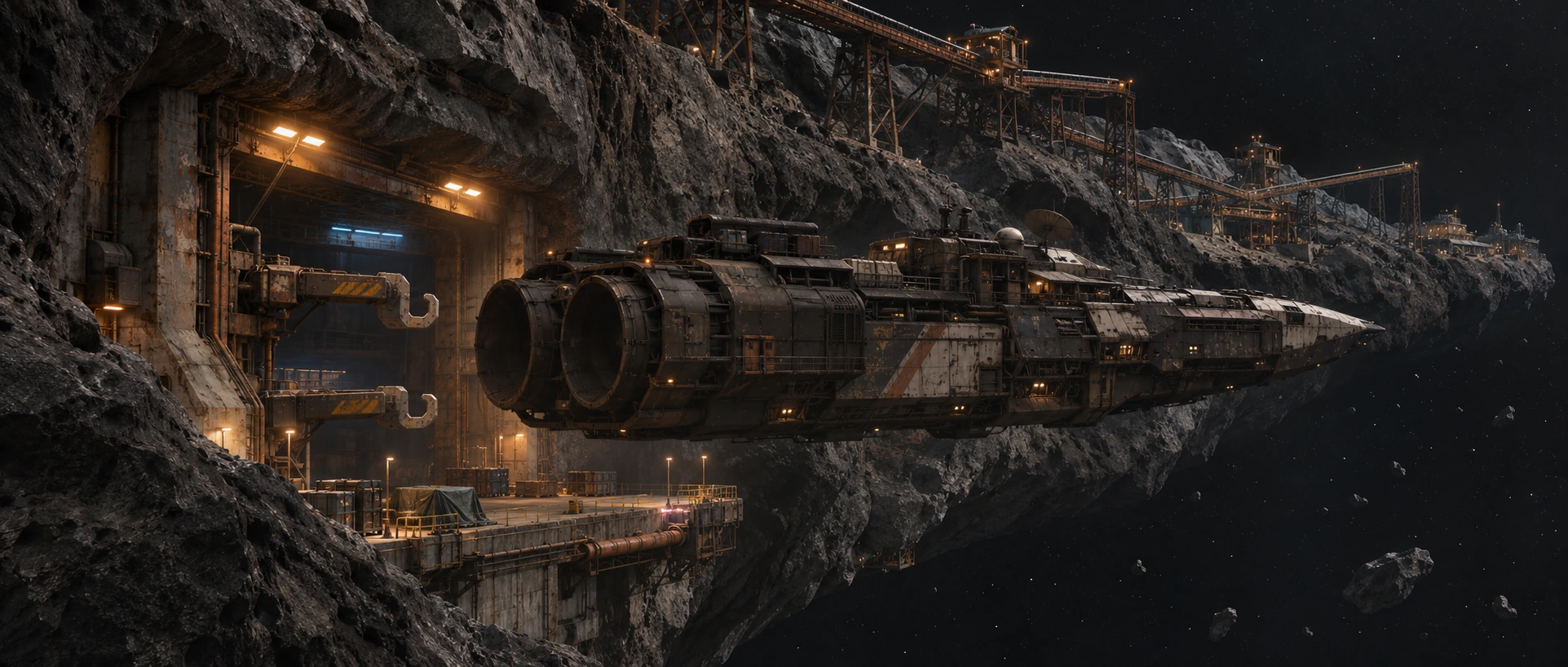
Ashfall Quay made ships enter stern first. The original ore works had been cut into the end of a long tumbling rock, and whoever inherited the works had found it cheaper to bolt a port to the opening than to change the way the rock turned. A visiting ship decelerated through a forest of abandoned conveyor trestles, showed the Quay its engines, and took the hooks that came out to meet it. Departures were very easy.
Leila had always liked that arrangement.
This time the berth clerk asked her to declare a conflict of interest before he would let the hooks down.
“I’ve several,” she told him. “Which one has come ahead of me?”
“Cargo from Argos.”
“We carry a great deal of cargo from Argos. Have you a shipment number?”
“Someone has filed a statement about your arrival.”
“Is it a cargo statement?”
“It’s a witness statement.” The clerk sounded apologetic. “You can dispute it on the inner ring. I only have to ask if you’re likely to shoot anyone over it.”
She looked past her pilot at the open berth. Beyond the trestles, sunlight moved in a strip over the struts and stayed clear of everything they were about to touch.
“Likely is a strong word,” she said.
The pilot took his hands off the controls.
“No,” Leila said. “You can put no.”
The hooks descended. As they took the Serendipity, the rock's spin came through the soles of her boots, faint at first and then sure. She waited until the bridge had finished the business of arriving before she asked who had made the statement.
The clerk couldn’t read her its contents. It was already being sold in the concourse.
There was a fish shop at Ashfall with three illuminated windows, each showing the same fish against a different background. People who liked to see the sea behind a thing they were about to eat stood at one window. People who trusted the cleanliness of a tank stood at the next. At the third the fish swam through absolute black. That window usually had the longest queue.
Leila sent her pilot for fuel figures and bought a paper from the stall outside the shop. There was a port edition and a relay edition. She paid for both.
Tavi Ren had sold an account of striking a depot booth with a cargo tractor. He told the port reporter who had hired him and how. He said he had driven under a temporary identity granted for the shift. He said he had been told the booth would be empty and had waited until a man left it. He recounted the restraint, the smoke and his transfer to the Serendipity. He gave the date, the place, the terms of his original work and the amount he had received in wages. The reporter had printed the wage as a figure. Leila had once bought an Argonaut patrol schedule for less.
The relay edition had a voice recording. She stood in front of the black window, among people waiting for their fish to be wrapped, and listened to Tavi explain the pause.
“There was a cup down beside the control board,” he said. “I could see it getting nearer when I came up in the tractor, and the man taking a sip. It was too far to tell what he looked like. He drank out of a white cup. I sat there until he took it with him.”
She opened the time extract he had provided. The shipboard plan allowed a few seconds between the booth impact and the interruption to the depot systems. The extract put his delay inside that allowance. On the Serendipity, they had assumed the clock differences accounted for the spread.
By the published account, the action to clear the freight floor had taken place after Tavi saw the man drink. The longer she looked at the time line, the less room there was for the version she had promised her crew.
They had drawn the relief clerk's likely route in blue and reserved the booth in grey. The planner had worked it from an Argonaut roster and two depot photographs. Leila had shown the drawing to the crew as evidence that there would be no one inside. She had marked it confirmed herself. It would have been easy to add another line requiring Tavi to wait for clearance. It would have been easier still to tell him he could stop.
The woman in front of her bought two fillets in the black window and asked the seller to wrap them separately. Leila stood aside for the next customer.
The reporter had offered the captain of the Serendipity an opportunity to reply. His office was on the upper market, in the old payroll row. She went there to find out what an opportunity cost.
The reporter's name was Dalm Miro. He used to put his name on freighter manifests that he knew had been altered. Now he reported on people who altered freighter manifests. He kept a pane of smoked glass on his desk from his old dispatch window. Through it the tops of his fingers looked bruised.
“Did he tell you how he got here?” Leila asked.
“Cargo liner. Third-leg transfer. He said you paid for the surface berth at Argos and left the rest to him.”
“I did. What did you pay him?”
“I’m allowed to keep that between us.”
“I’m allowed to ask what my name goes for.”
Dalm showed her the port tariff. Its witness rate was the same whether the person identified was Leila, an outpost cook, or a chairman with eight subsidiaries. Reproduction on paying relays earned a smaller amount each time. For Tavi it would cover a month of food if the story traveled. For Dalm it covered a clerk to answer people who wanted to speak without being made to wait on the stairs.
“Who bought advance copies?”
“We don’t sell advance copies.”
“Who was offered one?”
“Based on when I took his statement and when you came in, everyone on this rock.”
She asked to hear the entire interview. He gave her a terminal and went to make himself a drink.
At the end of the original recording, Dalm asked Tavi what had gone missing in the depot. He said he had never seen the cargo. Dalm asked who owned it. Tavi told him to ask the depot. Asked why he had come to Ashfall, Tavi said he had been to two offices on Argos where men were waiting for him to sign what had happened. One worked for the depot. The other said he could lift the transit hold on Tavi's old contractor number.
“Could he?”
“I expect so. He could put it back, too.”
“Did you sign what he gave you?”
“You have my signature here.”
The recording continued long enough to include the sound of a chair being moved away from the desk. Dalm had left that in. Leila took the headphones off.
A long time ago, on a lighter whose vessel name had changed every time it changed orbit, a woman had loaned Leila the cost of treating her left hand. The clinic wanted a recovery address. Leila had been unable to name one where she could receive the next adjustment and remain invisible to the people whose ship she had left. The woman put both of them under the same address and paid for enough dressing to take away. Then she kept the clinic receipts. At first the arrangement meant she could call and remind Leila the hand was due to be seen. Later it meant she could show a ship's purser how much of Leila belonged to her.
The argument that ended the arrangement had been about a twenty-minute delay. Leila had spent most of those minutes watching a cargo light through a cabin window, certain that it would go out when whoever was coming to check on her changed their mind. Afterward she used the hand almost normally. Her first private earnings went on keeping the woman at a distance her schedule could measure.
There were different ways to make somebody appreciate twenty minutes.
“You said I could reply.”
“You can.”
“If I make you an offer for the recording?”
“For a copy?”
“For the right to correct the names before it moves onto another relay.”
“It’s entered at the Quay already. I could take it off the stall and there would still be copies.”
Leila watched him set his drink on the smoked glass. The little clunk reminded her of the cylinder settling into its inspection hood.
“What did he redact?”
“The name of a friend on Argos.”
“He has a friend?”
“He says so. He could have ten.” Dalm took a sip. “You can leave a message for him down on the fourth. There’s a small office where people arrive out of sequence. The woman there keeps a letter drawer.”
He gave her the address without being asked what he would charge. She distrusted the gesture right away, then considered how long a delay it had bought him if she went looking for Tavi instead of standing there.
She thanked him and took the stairs.
On the fourth, the letter drawer held a stack of résumés in three transparent packets, a set of worn baby clothes, and a sealed case full of instruments for a ship that no longer stopped there. The woman at the desk took visitors by appointment. Two arrived while Leila was working out how Tavi might be encouraged to come and speak to her. The first had lost a berth through an injury he couldn't afford to name. The second wanted a passage for an older dog.
Tavi arrived carrying a bucket.
He washed windows on the market level. The work was apparently better before everyone arrived to buy fish. His sleeve was wet at the elbow. He paused at the entrance long enough to see whether anyone had come with Leila, then set the bucket inside.
“Have you finished asking other people where I am?” he said.
“Is the friend here?”
“Getting the dog travel documents.”
The woman at the desk handed him a towel. He stopped for the brief time it took to dry his arms and put it back. Leila went to a bench under the stairs. He sat down at the other end.
“I have a lawyer who’s going to say you breached an agreement.”
“Is she any good?”
“She usually tells me what I hope to hear first.”
Tavi drew his knees in so a porter could pass between the bench and the desk. He told Leila he'd read her agreement again before he went to the reporter. He hadn't described the ship’s interior. He couldn't say what the cargo was. He'd kept her pilot's name out because he'd spoken to the man for half a minute and couldn't think of anything the man had done to deserve being looked for.
“You think I’d want to look for him?” she asked.
“I didn’t want the depot looking for him.”
The exchange made her angry enough to turn toward him. He appeared to catch the change in the angle of her shoulder. He kept his face level anyway. She wondered who had taught him to do that.
“There was a part I left out,” he said. “You agreed to let me leave.”
“I paid for you to leave.”
“Yes. I could have said you made me a prisoner, and they’d have printed it bigger. I told Dalm exactly how long you kept me, including the part where the door stopped being locked.”
“Why did you tell them my name?”
“So they'd know I had one, too.”
She was going to say a name was simply a tool, partly because to her it had been, and partly because she knew it would cause him pain. From the desk came the slow wheeze of the old dog everybody was talking about. Leila leaned forward and watched a woman crouch to get both forelegs into a harness. The dog had a way of standing on the slack while the woman tried to pull it through.
“People are offering work on my behalf,” Tavi said. “Someone says they’re acting for you.”
“Anyone worth working for?”
“An agent outside the stairwell. He put down a transfer voucher for passage and a deadline. I don't owe him a berth.”
Leila asked what the work was. He'd been expected to give an account to a commercial custodian with rights of examination. The name at the bottom was a Quay broker's. The destination line held a number and a space where a vessel name might go. He'd left the voucher at the desk for a woman who knew how to make copies of things without filing them in the public register.
“Did they ask what you saw on the ship?”
“They asked what I touched.”
The anger that Leila had ready for him had to go somewhere. She was used to that small, cumbersome transfer, to finding another person she could put it on before she had to feel it leave her. This time she let Tavi finish talking. The offer had made it to him before the paper went on sale. Whoever sent it already knew where he'd made landfall.
“You could run from here,” she said. “They’ll have to find you again.”
“They'd get to do it again. That's a little different.”
He scooped the bucket up. Some of the water leaked from the lip as he went. A few minutes later he came back with a piece of newspaper from the washroom and set it down over the wet patch. She almost asked what he'd bought with his first earnings. He was gone before she could.
On the Serendipity, her pilot had left the report open beside the bridge timetable. Someone had highlighted the line about the white cup.
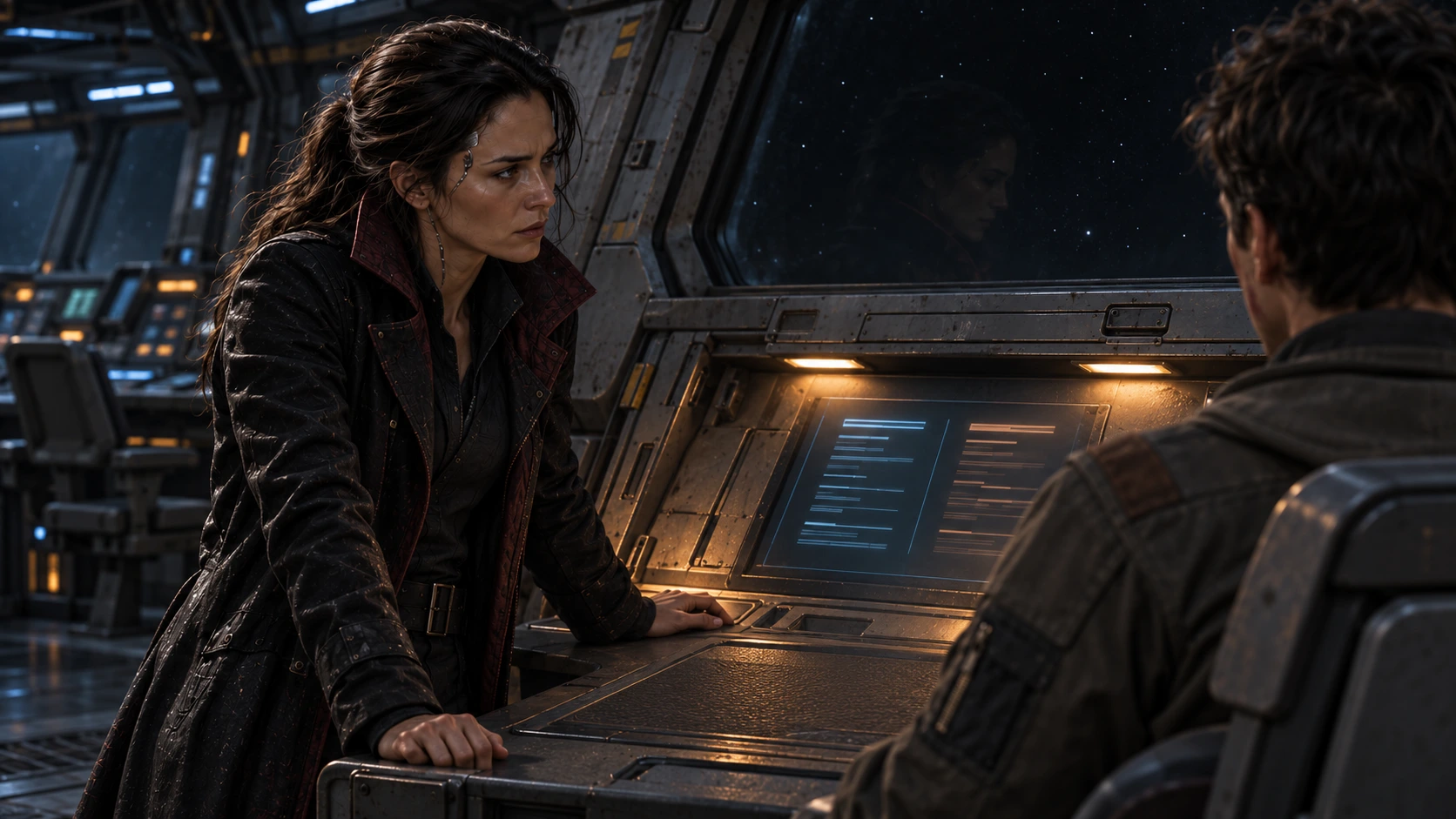
“Everyone who’s ever sat in one of those booths has a white cup,” he said.
“You ever sit in one?”
“No.”
“Then you've probably got the color wrong.”
He started to shut the report. She told him to leave it. On an unused corner of the timetable she put up the plan from Argos, and beside it the arrival evidence the depot would have recorded. There was Tavi's delay. There was her confirmation. Someone she trusted had given her an answer that looked closer to a yes when she opened it in a hurry. She could remember saying to the crew that her contact had confirmed it, and could no longer recover the original degree of conviction in the contact’s voice.
“May I ask you something?” her pilot said.
She nodded.
“Would we have gone through if he'd come up at the proper time and hit it?”
She unfastened her left cuff. Under it the old dressing line was a paler part of the skin. It didn't hurt now. She had to touch it to check.
“I would have gone through,” she said.
He nodded once. By evening one of them would still be thinking about the answer and the other would think about why she'd asked her pilot to leave the report open. For now the ship needed a landing declaration. She typed the reply to Dalm before she could use the berth as an excuse not to.
The man at the booth left before Mr. Ren took action. Mr. Ren waited for him. I had given Mr. Ren no instruction that would have guaranteed that result.
The pilot read it from where he stood.
“Is that going out over your name?”
“Yes.”
Once the reply entered the market relay, the port’s underwriter froze her old recovery rate. It would be an hour's work to negotiate another, at a price she'd resent for the rest of the week. The evidence of where the cylinder had come from and what it promised remained hers. Beside the bridge schedule, the berth clerk’s second message carried a request from the port examiner to confirm the contents of the shielded case. Someone had attached a commercial interest in it. A second message attached a different claimant.
Leila left both unopened while she made herself eat. They could make claims against the cargo. They could stand at the foot of the ramp and offer money to anyone they recognized. The account of the booth now had a life outside her ship. She wouldn't get it back by keeping a man alone in a room.
When she went through to the inspection bay, none of the diagnostics were on. She sat beside the hood and gave the Quay’s slow, local gravity time to tell her where down was. From under the hood came the ordinary cooling click of metal. She'd spent the whole afternoon waiting for somebody to ask her what she'd brought.
She finished the meal there, beside the thing that had yet to cost her its real price.