
Terms of Recovery
While Argos waits for the Deep Blink, Captain Leila Darkstar prepares to steal a sealed consignment. The delay has already cost her time. What happens next may cost her considerably more.

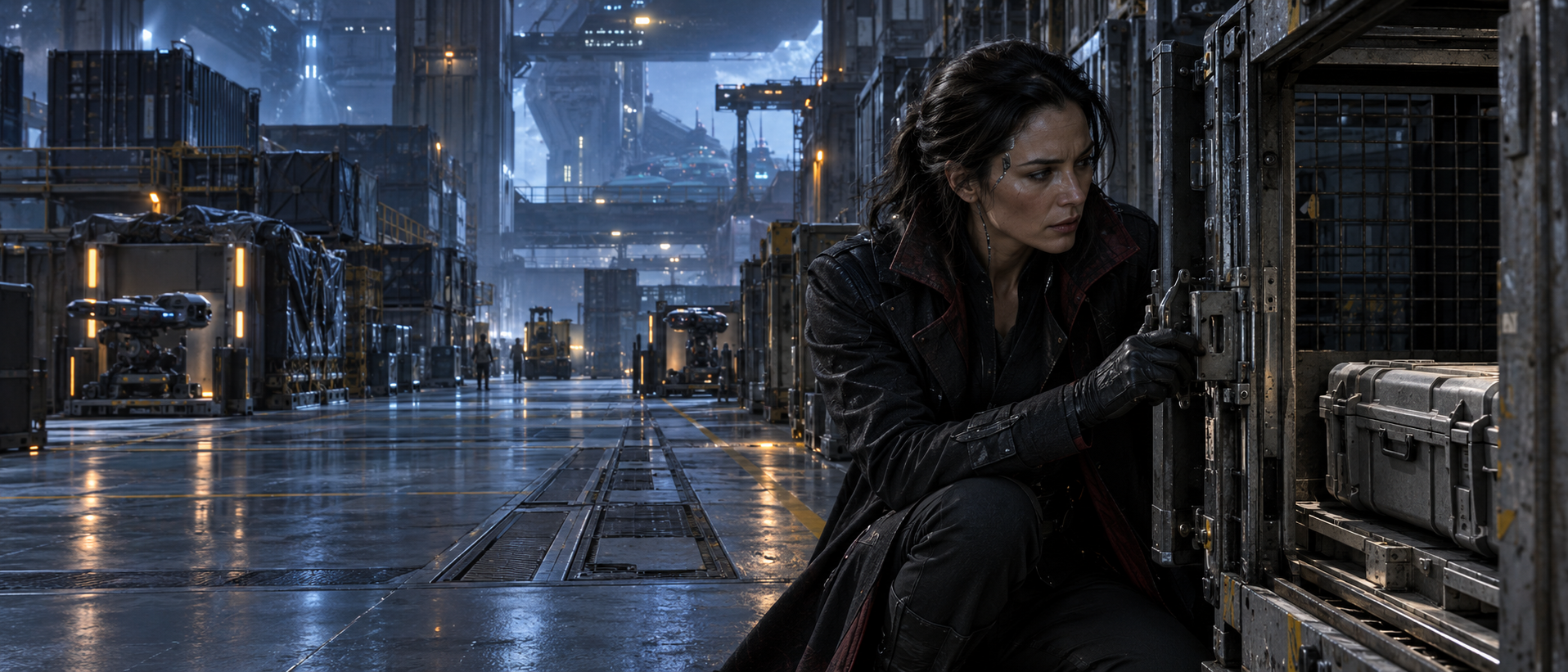
Captain’s Log: 2734 — Argos
While Argos waits for the Deep Blink, Captain Leila Darkstar prepares to steal a sealed consignment. The delay has already cost her time. What happens next may cost her considerably more.
The drink arrived just as the feeling returned.
Leila left it on the table.
The familiar pressure behind her eyes sharpened, traveled down the left side of her neck, and settled beneath the skin of her wrist. Her implants reported no fault. They rarely did when this happened, which she considered a failing on their part.
Across the cantina, the owner struck a speaker grille with the heel of his hand.
“Won’t make him talk faster,” Leila said.
“Worked last year.”
Her private channel opened.
“Still holding,” said the pilot above her. “I’m getting inquiries.”
“Be charming.”
“They want an explanation for the approach vector.”
“Be convincingly stupid.”
Outside, well above the district, the Serendipity was drifting through the margins of an assigned holding lane. Leila could see the ship's position on her wrist display, along with the patrol that had begun matching its course.
Phox Security. Prompt, suspicious, and currently being paid to look in precisely the wrong direction.
On the surface, three hired pioneers waited for three unrelated instructions. One believed he was helping settle an insurance dispute. Another thought she was retrieving a stolen navigation package. The third had sensibly asked no questions beyond how much and when.
None knew what Leila intended to take from the bonded transfer depot behind the cantina.
Leila knew its dimensions, its weight, and the number on its seal. She knew it had arrived without a declared origin and had spent nine days in a cage whose daily rental exceeded the price of a small ship.
She had paid dearly for those facts.
The contents would be a pleasant surprise.
The first pulse sounded.
Every conversation stopped.
Leila's fingers closed hard around the edge of the table. The second pulse passed through her wrist with such precision that she briefly thought something had touched her from inside it.
By the fourth, she was looking at her implant diagnostics.
By the sixth, she had stopped trusting them.
The seventh faded. A glass rolled off an adjacent table and broke.
“That yours?” asked the pilot.
“No.”
“You sure?”
She muted him.
Then The Speaker's voice arrived, calm and familiar, beginning the eulogy.
The cantina lights descended into their ceremonial blue. Outside, the depot's heavy freight doors began closing for the observance, while its internal systems changed to the reduced operating schedule she had purchased from an employee who had since found it advisable to leave Argos.
Leila stood.
“Now.”
Above the district, the Serendipity reported a containment failure.

It accompanied the report with a broad plume of incandescent coolant and enough fabricated telemetry to suggest that the next few seconds might become historically expensive. The Phox patrol turned toward it. Other ships began requesting permission to leave their lanes.
At ground level, an autonomous freight tractor accelerated through an empty customs booth. Three streets away, a cargo alarm identified six different vehicles as carrying the same restricted reactor assembly.
Argonaut units moved toward both incidents.
Leila crossed the alley behind the cantina, applied a borrowed palm to a service reader, and entered the transfer depot.
The palm was a flexible cast. Its owner was still alive, although unlikely to appreciate the distinction.
Inside, blue floor strips outlined empty freight lanes. The eulogy followed her through overhead speakers. She passed stacked food containers, sealed machine parts, a pallet of children's water filters. Two security drones hung motionless in their charging frames.
Those would remain asleep for another forty seconds.
She reached the inner cage in twenty-three.
It was open.
Leila stopped just short of the threshold.
The latch had withdrawn. No cut marks. No damage to the frame. Inside, a grey case rested alone on a low freight cradle.
Her stolen access sequence remained unspent on her wrist.
“Someone beat you?” the pilot asked.
She had forgotten to mute the local camera feed.
“If they did, their attention to detail is disappointing.”
She crouched beside the latch. Its maintenance light showed authorized access. On the display above it, a release time had been recorded seventeen seconds before she entered the depot.
During the pulses.
“Captain.”
“I see it.”
An open cage cost less time than a closed one. She stepped inside.
The case weighed just under eight kilograms. Its seal number matched. She ran a passive scan along the sides: dense shielding, no measurable emission, something approximately cylindrical nested within. A removable inspection plate covered one end. Beneath it, visible without breaking the main seal, was the identifier her source had described.
It matched too.
For an instant she felt foolish for being disappointed. There should have been some visible consequence of all that money and preparation. A little radiance, perhaps.
She fitted a carrying strap and turned toward the exit.
The two drones woke.
Their frames clicked open.
Leila looked at the countdown on her wrist. Nine seconds remained.
“That,” she said, “is irritating.”
She fired into the nearest charging frame before the drone could rise. The second lifted through the smoke, rotated toward her, and began extending its weapon.
Leila ducked behind the water filters.
Rounds tore through the pallet. Plastic burst across the lane. She rolled under a freight conveyor, dragging the case after her, and fired twice into the drone's exposed underside.
It hit the floor hard enough to split its casing. One rotor kept spinning.
The Speaker continued through the gunfire.
“West door,” the pilot said. “Two minutes until I have to stop pretending.”
Leila crawled out and examined her sleeve. A round had passed through the loose fabric beside her elbow. She had liked this coat.
“Keep pretending.”
She took the case toward the west door.
Her surface shuttle was waiting beyond a loading yard. Between her and it stood an Argonaut armored carrier.
The tractor pioneer knelt beside the carrier, hands behind his head.
Leila stopped in the shadow of a freight stack.
“You said an empty booth,” he whispered over their channel.
“It was empty.”
“They got here.”
“Yes. That was the purpose.”
An officer caught his wrist, pulled it down, and stripped away his communicator. The channel went dead.
Leila examined the yard through the gap between containers. Two officers, both watching the prisoner. Her shuttle's berth was visible beyond them. So was the customs gate she had arranged to hold open.
It was closing.
She could take the east exit, lose eight minutes, and likely arrive at an impounded shuttle. Or she could put a round through the nearest officer's helmet and discover how quickly the carrier acquired targets.
Neither appealed.
She opened a public distress frequency.
“Transfer depot west yard. Two armed men impersonating Argonaut personnel. Civilian detained. Request immediate verification.”
She attached six seconds of video and transmitted it under the freight contractor's identity she had used to enter the building.
The officer's wrist lit up.
He looked down, then sharply toward the depot.
Leila had already moved.
She crossed behind the carrier while both officers challenged the anonymous report, slid a magnetic charge beneath its rear step, and continued toward the shuttle. At the edge of the next stack, she triggered it.
The carrier's alarm shrieked. Smoke poured from the step. A suppression jet struck the first officer hard in the chest.
The prisoner ran.
Leila reached her shuttle, opened the hatch, and was nearly inside when a hand caught the lower rung.
The pioneer hauled himself up beside her, panting.
“You came back.”
“You’re blocking the hatch.”
He scrambled inside.
She considered putting him out again. Behind them, the smoke was thinning. Keeping him was quicker.
“Rear seat. Touch nothing.”
“I thought you’d left me.”
Leila secured the case beneath the forward console.
“Then you were paying attention.”
The shuttle cleared the yard under a medical transport identity and climbed through a service corridor kept open during the observance. Below them, the district remained dark except for emergency lights and a spreading constellation of customs vehicles.
The Serendipity had recovered miraculously from its containment failure. Its pilot was supplying Phox with an elaborate account of a valve defect and thanking them with enough sincerity to become offensive.
Leila let the shuttle handle the final approach.
“What’s in it?” the pioneer asked.
“Your bonus, if you stop talking.”
He stopped.
She brought up the case's freight record again.
The arrival entry, seal number, and mass were all where she had left them. A new line appeared beneath the depot location.
COLLECTED.
That was inconvenient. It should have remained listed in the cage until the depot completed its next inventory sweep.
She opened the custody record, expecting the identity attached to the borrowed palm.
The collection had been authorized before she used it.
Seventeen seconds before she entered the depot. The same time as the cage release.
“Put the ship's cargo reader on local only,” she told the pilot. “No network. No automatic inventory.”
“What did you steal?”
“I’m beginning to wonder.”
In the Serendipity’s transfer bay, Leila locked the pioneer in an empty passenger compartment, promised him money, and ignored his attempt to negotiate the order of those events.
She put the case inside a shielded inspection hood.
Through the hood's gloves she removed the outer freight tag. Underneath was a second label, so worn that its lettering came away in pale flakes beneath her thumb. The case had been shipped before. Many times, judging by the adhesive in its seams.
She broke the commercial seal.
Inside lay a dark cylinder with ceramic end caps, secured in a fitted cradle. One cap carried a narrow row of recessed contacts. The other bore no marks at all.
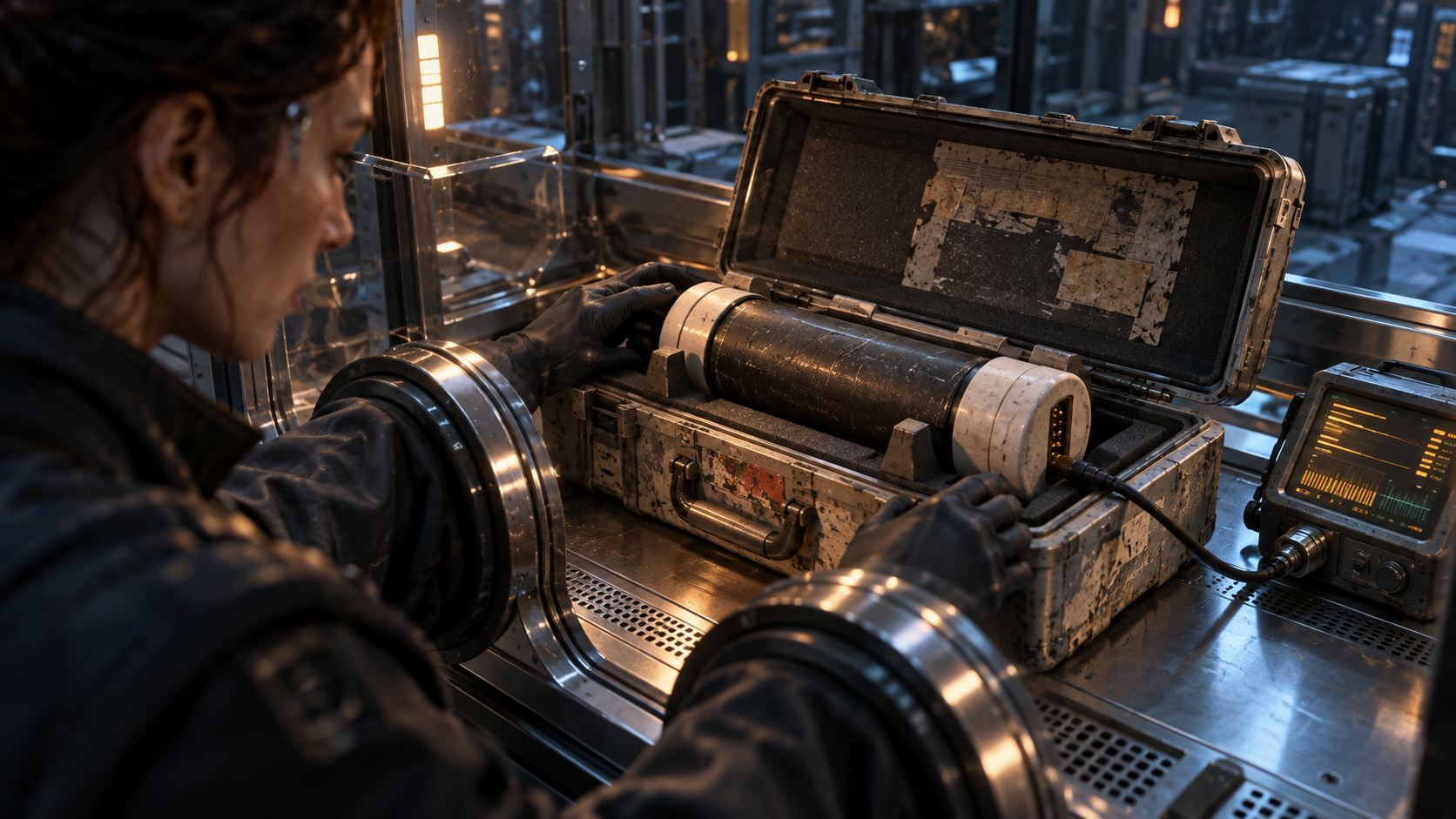
Her wrist began to ache.
Leila pulled both hands out of the gloves and stepped away.
The feeling subsided.
She stood still for several seconds, listening to the bay ventilation. Then she returned to the hood and fitted an isolated reader to the contacts. No wireless access, no ship connection. The reader's small screen lit up.
An identification request produced a string of numbers and an error.
A contents query produced nothing.
The third menu offered transit documentation. That, at least, the object understood.
A receipt appeared.
RECOVERY ACCEPTED.
Below it was the time the cage had opened.
She scrolled.
The form had places for handling restrictions, transfer authority, and a return destination. The restrictions were blank. The authority field contained another unhelpful string of numbers.
The destination contained a name.
Leila read it twice.
Then she checked the reader's isolation light. Amber. Local power, physical connection only. The little machine had no access to her navigation records or the ship's archives. Whatever it was showing her had come out of the cylinder.
“Captain?” the pilot asked through the bay speaker. “Phox wants to know where we’re headed.”
Leila looked at the name again.
She had heard it as a child, half listening to a teacher explain how people had first come to Argos. It belonged in memorial speeches, above museum doors, beneath pictures of people whose descendants no longer remembered their faces.
RETURN TO VESSEL: THE CONSTELLATION.
“Captain?”
She disconnected the reader and set it carefully beside the hood.
“Tell them we’re still deciding.”