
The Silence
Maris Sinclair is trying to get home before the Deep Blink. Beneath Argos, a crowded transit station waits for a familiar voice—and hears something else.

Captain’s Log: 2734 — Argos
Maris Sinclair is trying to get home before the Deep Blink. Beneath Argos, a crowded transit station waits for a familiar voice—and hears something else.
The woman at the housing counter had brought the wrong death certificate.
It belonged to her husband. The lease belonged to his mother, who had died eleven years earlier, and until someone established the legal passage of the apartment from one dead person to the next, the housing system regarded the woman and her two children as unauthorized occupants.
“I’ve lived there for nineteen years,” she said.
Maris had been ready to leave. Her bag was fastened. Beyond the counter, the other desks were already dark.
She set the bag down.
“What was his mother’s name?”
By the time she had found the archived tenancy and placed a hold on the eviction, the last express lift to the surface had gone. The woman thanked her three times. Maris told her to keep the receipt, and watched until she put it somewhere better than the open pocket of her coat.
Then she took the stairs to the transit station.
She had intended to spend this Deep Blink aboard her shuttle. There was food in the cold locker and a troublesome seal beneath the pilot’s seat that she could fix while everyone else remembered the dead. She had even bought the seal.
It pressed against her ribs through the side of her bag as she hurried down the steps.
Above the platform, the departure board showed a single line.
SERVICE PAUSED FOR OBSERVANCE.
Maris stopped beneath it, breathing hard.
“Just missed it,” said a man with a cleaning cart.
“Apparently.”
“You and everyone else.”
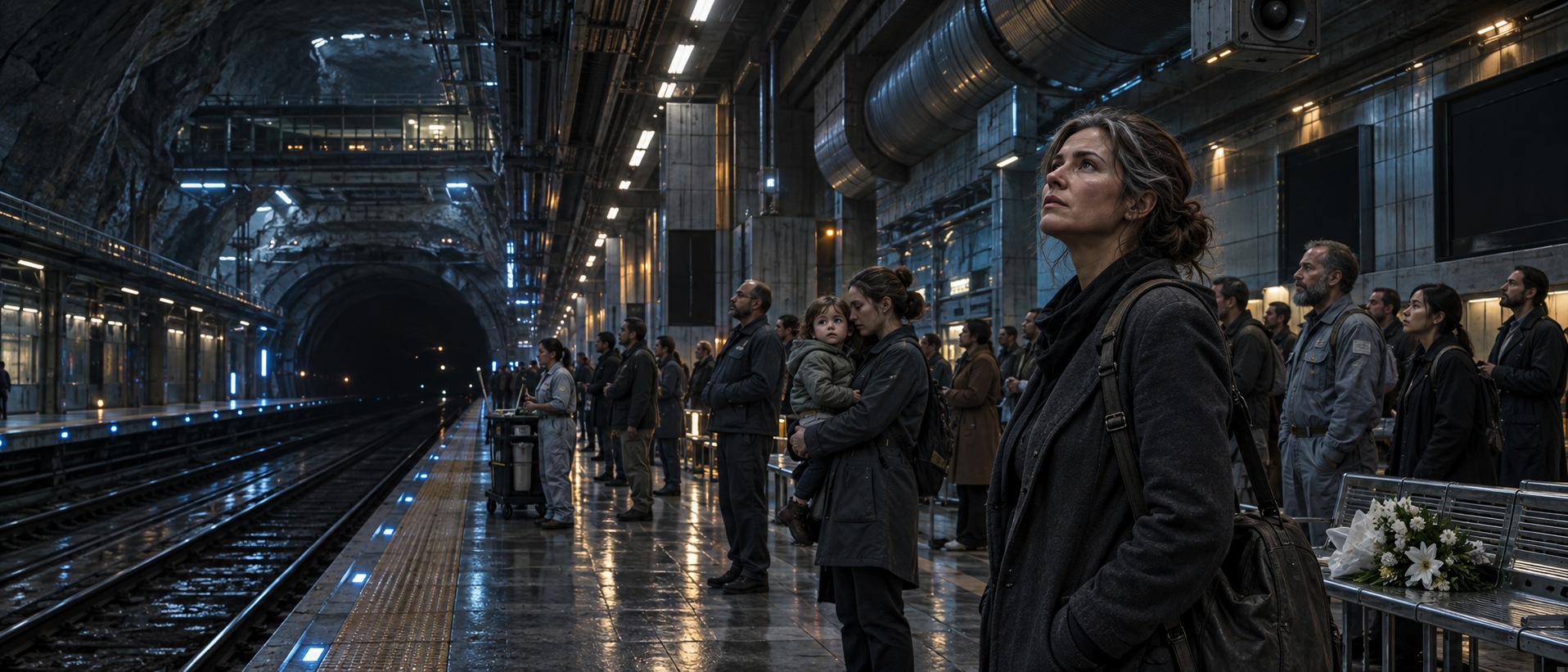
There were perhaps sixty people on the platform. A cluster of workers in grey coveralls. A woman holding a sleeping child against her shoulder. Two young men eating something from a paper sleeve and arguing quietly about who had paid. Someone had left a small bunch of white flowers on a bench, occupying a seat that nobody asked to use.
The station lights faded to their waiting level. Advertisements vanished from the tiled walls. A woman on a screen above the stairs stopped smiling halfway through an invitation to live somewhere with a view of the sea.
The fans continued overhead. So did the distant pumps. Down here, even remembrance required a certain amount of machinery.
Maris found a place beside a service door.
As a girl, she had counted the lights going out across the buildings opposite their house. Nolan had always tried to count faster, announcing a number before she had finished. Their mother would make them start again. Their father would tell them both to be quiet.
This year she had nobody beside her to count with.
She took out her terminal and opened a message to Nolan. His last transmission had arrived three days earlier: a photograph of a blue star, with no explanation of where he was or why he thought she needed to see it.
She had meant to reply.
Are you somewhere with a window? she typed.
It looked foolish. He was always somewhere with a window.
She deleted it and put the terminal away.
Usually, by now, The Speaker would have begun.
Across the platform, a worker checked his wrist and looked up at the nearest grille. The cleaner stopped wiping the handle of his cart. For a few moments the only distinct sounds were the fans and the crackle of the paper sleeve between the two young men.
One of them folded it carefully shut.
Still nothing.
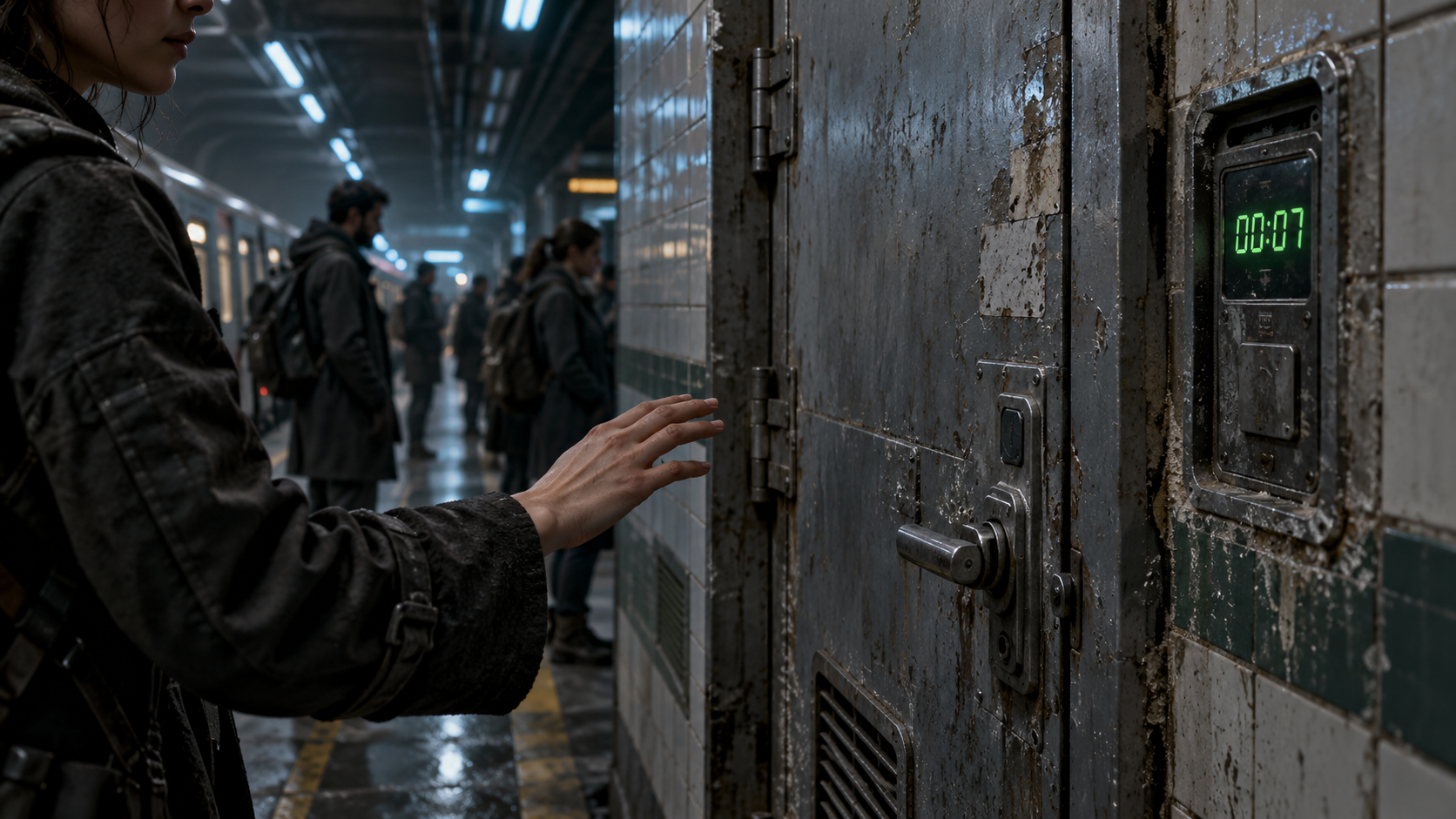
Maris looked at the service panel beside her. Most municipal fittings were familiar to her in the abstract: diagrams attached to maintenance claims, serial numbers in disputes over replacement costs. This one was older than the door it served. Its green lettering had burned faint ghosts into the display.
LOCAL CONTROL AVAILABLE.
She watched it change.
PLEASE WAIT.
Below that, a number appeared.
00:07
Maris glanced at the departure board. It still displayed the observance notice.
Six.
She moved her hand away from the service door.
Five.
“Finally,” someone said, mistaking her movement for the approach of a train.
Four. Three.
The woman shifted her sleeping child to the other shoulder. The cleaner looked at Maris, then at the little panel.
Two.
“Is that supposed to—”
The first pulse came through the station speakers.
Low and brief. A clean tone, too low to be a warning chime. Maris felt it against the fillings in her back teeth.
A second followed.
At the third, the child woke and began to cry.
Four. Five.
Everyone was looking up now.
Six.
The last pulse lingered a little longer than the others. Behind Maris, something shifted inside the service door: a heavy, dragging movement, followed by a click.
The panel went dark.
The child's crying filled the station.
Maris realized she had one hand flat against the wall. She took it away. Her fingertips were dusty.
“Testing the alarms?” the cleaner said.
She shook her head, although she had no reason to be certain.
Then The Speaker began.
“For those who crossed the darkness before us, and those who did not reach its end.”
The familiar voice came from every grille at once. Warm, evenly paced, without a catch in the opening words. Around Maris, shoulders lowered. Someone released a breath loudly enough to be heard.
The woman kissed her child's hair.
“There,” she whispered. “There it is.”
The Speaker continued. Maris knew the next passage, and the one after it. She had heard them standing beside her mother, and beside an empty place where her mother should have been. The words belonged to so many evenings that she usually stopped listening to them individually.
Tonight she listened to every one.
There was no mention of the delay.
No apology for the tones.
Beside her, the service panel lit up again.
LOCAL CONTROL AVAILABLE.
The cleaner bent to release the brake on his cart.
“That door,” Maris said quietly. “Where does it go?”
He looked at it.
“Utility access.”
“Do you use it?”
“No.”
“Do you know who does?”
He gave her the tired, appraising look she knew from people who suspected a simple answer was about to become work.
“Maintenance, I suppose.”
“It opened.”
The door was closed. She could see that he was looking at it, politely refraining from telling her so.
“I heard the lock,” she said.
He leaned toward the small inspection label beside the hinge, then straightened.
“Shouldn’t have. That one’s been taken out of use.”
“Since when?”
“Before me.”
He pushed the cart away as the eulogy reached its final passage.
Maris stayed beside the door.
When the train finally came, she let it leave without her.
The station emptied in a rush of footsteps and conversation. The white flowers remained on the bench. Someone had crushed the paper sleeve beneath a shoe, leaving a dark patch of sauce on the floor.
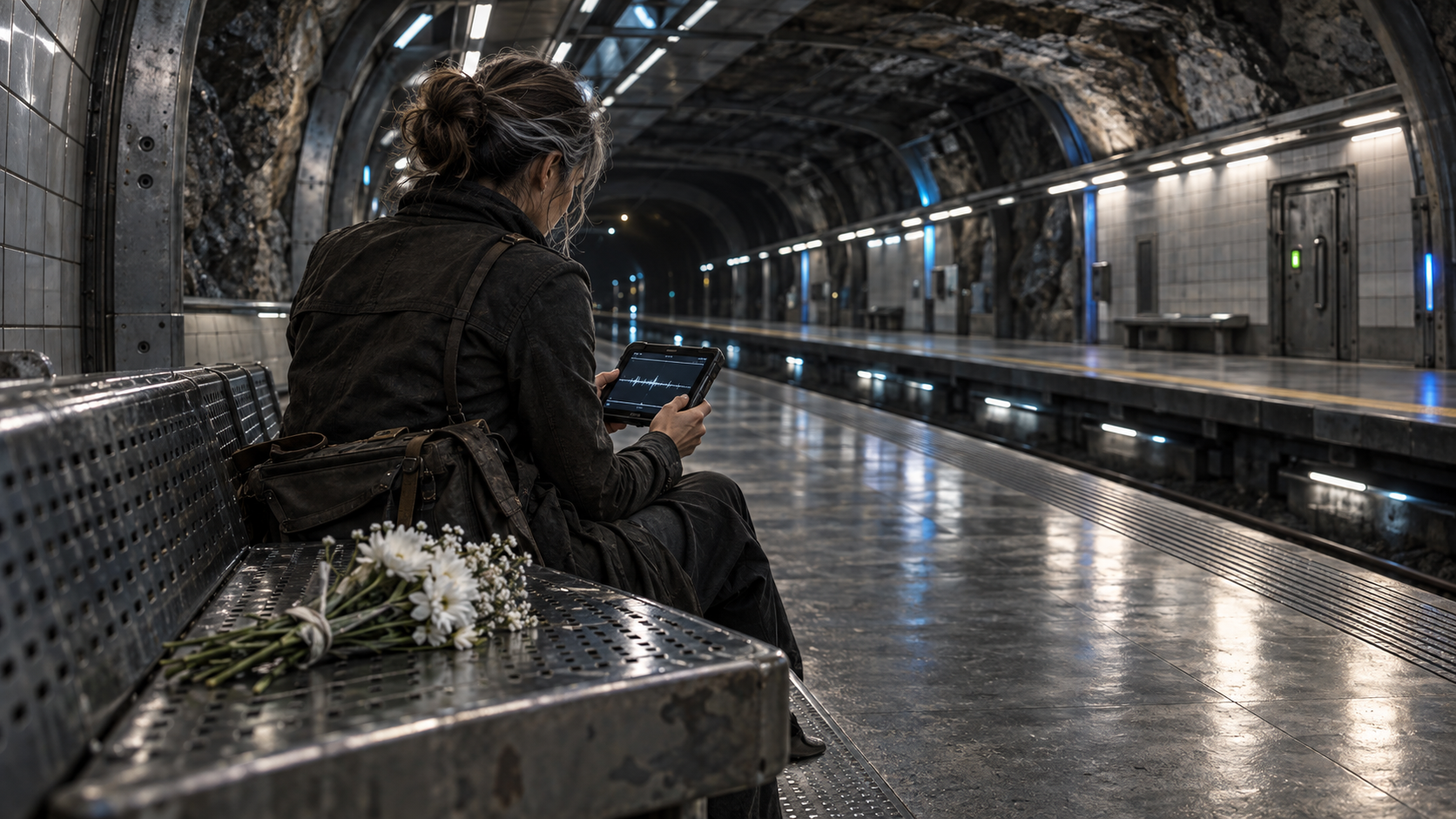
Maris sat beneath the departure board and opened the public observance feed.
The recording was already available.
She selected the station's local channel, expecting an announcement, perhaps a notice that a test signal had interrupted the service. Instead she found the usual entry, tagged with the usual ceremonial title. She played it from the beginning.
The Speaker began immediately.
She opened the longer station log. Her work credentials admitted her to the ordinary maintenance view: announcements, service interruptions, equipment faults. She found the pause in train service and moved forward through it.
Seven minutes and twelve seconds elapsed between the platform lights dimming and the start of the eulogy.
The audio for that interval was silent.
Maris checked that she had the right channel. Checked the date. Increased the volume until the first syllable of the eulogy made her flinch.
She listened again.
It proved less than she wanted. A recorded feed could omit sounds introduced at a local amplifier. The delay might be an ordinary fault. She had seen entire maintenance reports built around an apprentice plugging a cable into the wrong socket.
Still, there should have been a fault entry.
She opened the equipment list and found the service panel beside the door.
Its last recorded inspection was old enough to make her frown.
Its control status was clearer.
DISCONNECTED.
Maris looked across the platform. Green lettering glowed in the panel's little window.
She copied the log to her terminal, photographed the panel, then turned off automatic synchronization. It was a habit learned from disputed housing records: keep the version you had actually seen.
The next train was six minutes away.
She reopened the message to Nolan and considered telling him. He would ask which station, what frequency, whether she could get inside the service passage. Within a minute, something frightening would become somewhere to go.
She closed his name.
Instead she opened a blank note, entered the time, and described the sound as precisely as she could.
At the bottom, she added a sentence that felt unnecessary until she had written it.
The child woke on the third pulse.
Then she sat beneath the brightening lights and waited for her train.