
The Weight of Names
Jade Bootroot has brought a fortune out of Tien. Before she can sell it, someone must decide what to call the people who did not come back.

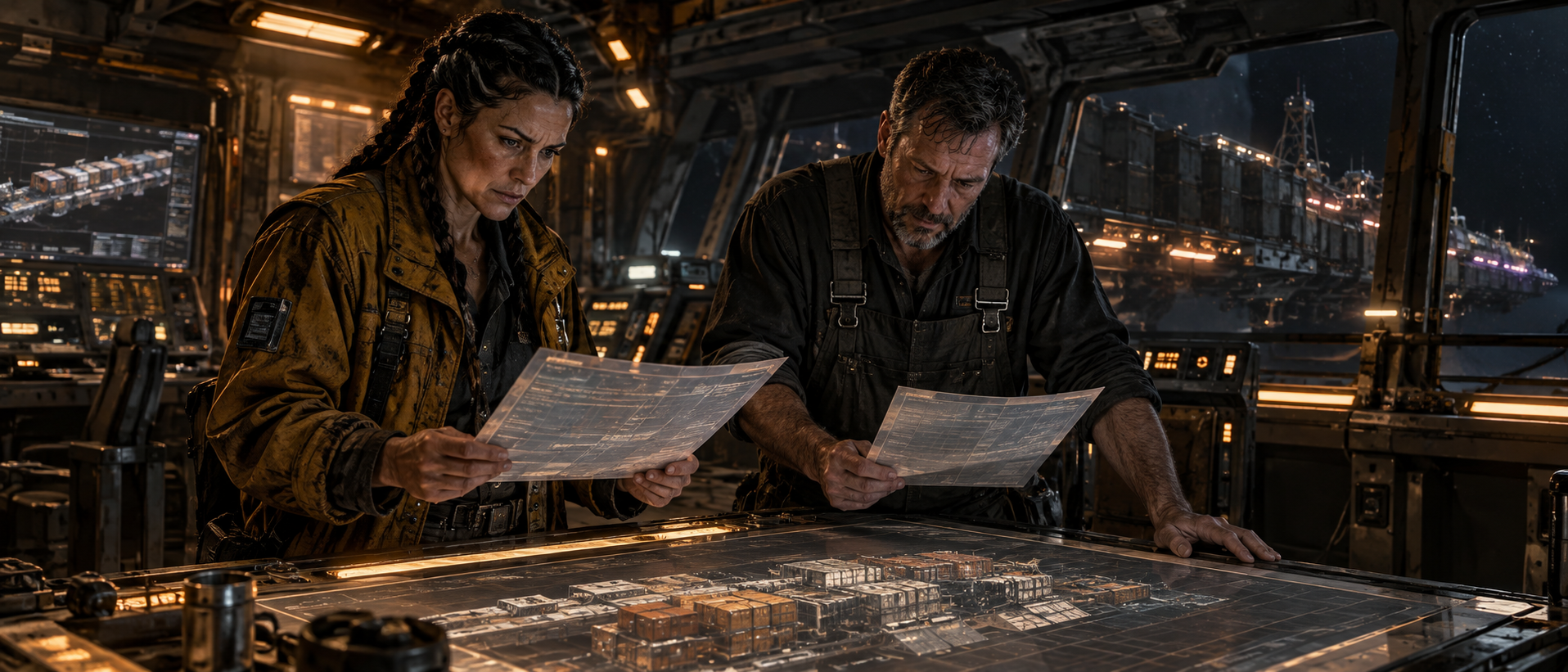
Captain’s Log: 2734 — Aboard the Iron Everest
Jade Bootroot has brought a fortune out of Tien. Before she can sell it, someone must decide what to call the people who did not come back.
The Grand Sub Captain carried the manifest in both hands.
That was how Jade knew there were two versions.
Tomas Orr usually tucked a terminal beneath one arm and complained about whatever task had kept him from sleeping. Tonight he crossed the bridge carefully, his boots making small, deliberate sounds beneath the steady labor of the engines.
“Cargo first?” he asked.
“People.”
He laid one sheet of printed film on the chart table.
They still printed the personnel lists. Screens changed too easily, and the crew preferred something a captain had to pick up and put down.
Jade read the first name. She had already read it in her head a hundred times.
Of those lost at the extraction site, some had been recovered and identified. Others remained behind the collapsed workings. Two had disappeared during the attack on the outbound tenders. The distinction mattered to the insurers, to payroll, and to every family waiting for an answer.
It mattered to Jade for reasons she had not managed to arrange into useful categories.
Beside the unrecovered names, Tomas had left the status fields blank.
“The advance depends on a final manifest,” he said.
“How final?”
“The lender sent a revision.”
He placed the second sheet alongside the first.
The offer would cover propulsion service, medical fees, and the berth they would need at Argos. It would also settle the expedition’s casualty account. Under its terms, the missing would become presumed dead; their open crew shares would be closed against the advance.
Jade read the line twice.
“They want the cargo free of claims.”
“They want something they can price.”
“Same sentence, better coat.”
Tomas did not smile.
The Iron Everest shook gently as a load regulator corrected the balance of the cargo holds. Tons of material lay beneath their feet, enough to make the expedition a success in every account that would never have to face the crew.
“How much time do we have?” she asked.
“Before the offer expires? Four hours.”
“Before we need the money.”
“Less comfortably.”
She went down to the holds.
At the pressure door a deckhand tried to stand too straight. He had a new brace on one wrist. Jade caught him preparing to hide it behind his back.
“Still painful?”
“Only when I’m moving crates.”
“Then don’t.”
“We’re short.”
“I noticed.”
She took his load key and handed it to the next shift lead. The boy’s embarrassment annoyed her more than an argument would have. She had spent years telling them she wanted honesty. They still watched her face to learn which version of it they could afford.
In Hold Three, the recovered material rested in sealed bins under survey lamps. A thin coating of Tien dust had survived every effort to keep it outside. It worked into the seams of gloves, the hinges of sample cases, the folds of skin beside a fingernail.
One small bin stood apart from the rest.
Its contents had passed ordinary contamination checks. They had failed to produce ordinary assay results. A repeatable thermal response appeared in the sample, then disappeared when the laboratory varied its preparation. The technician wanted another run. The buyer wanted the bin included at bulk grade.
Jade rested a hand on the lid.
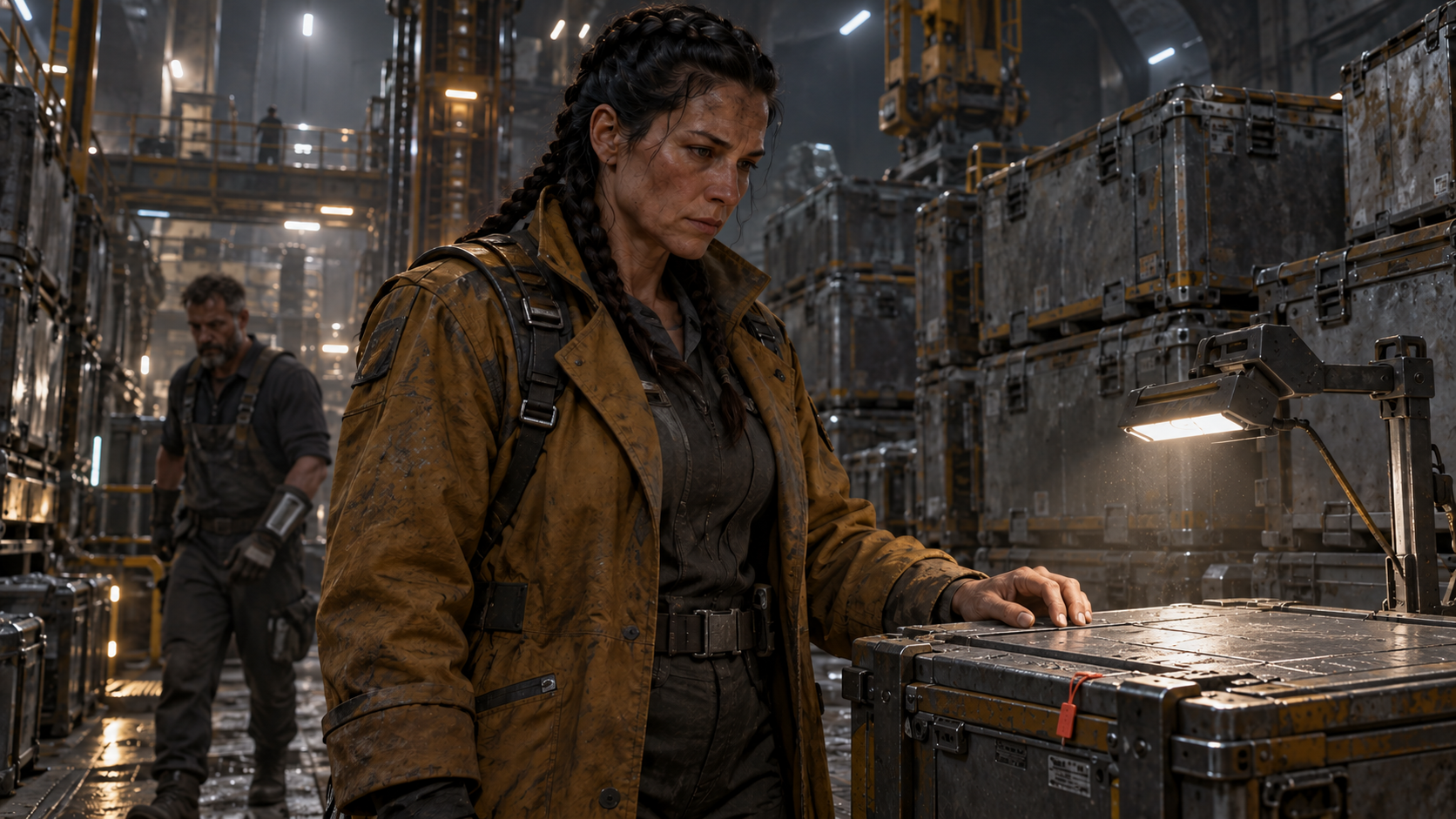
This was the seam she had ordered them to follow.
There had been warning signs before the collapse. A distortion in a support reading. A delay in the remote survey. She had judged both tolerable because another tender was already inbound and the crew was tired of losing time.
She could explain that judgment precisely.
It had not become easier to explain.
Tomas joined her at the bin.
“We can sell that separately,” he said.
“We don’t know what it is.”
“Someone will pay for that.”
“Someone will pay for a rumor. Then they’ll want me to repeat it.”
He leaned against the neighboring container.
“You could refuse the advance and still lose people. There are medical bills.”
“I know.”
“The rest of us are here, Jade.”
She turned toward him.
For a moment she heard disrespect where there was only exhaustion. Then she saw how badly the skin beneath his eyes had darkened.
“Yes,” she said. “You are.”
The message from Ena Voss had arrived in the last relay bundle.
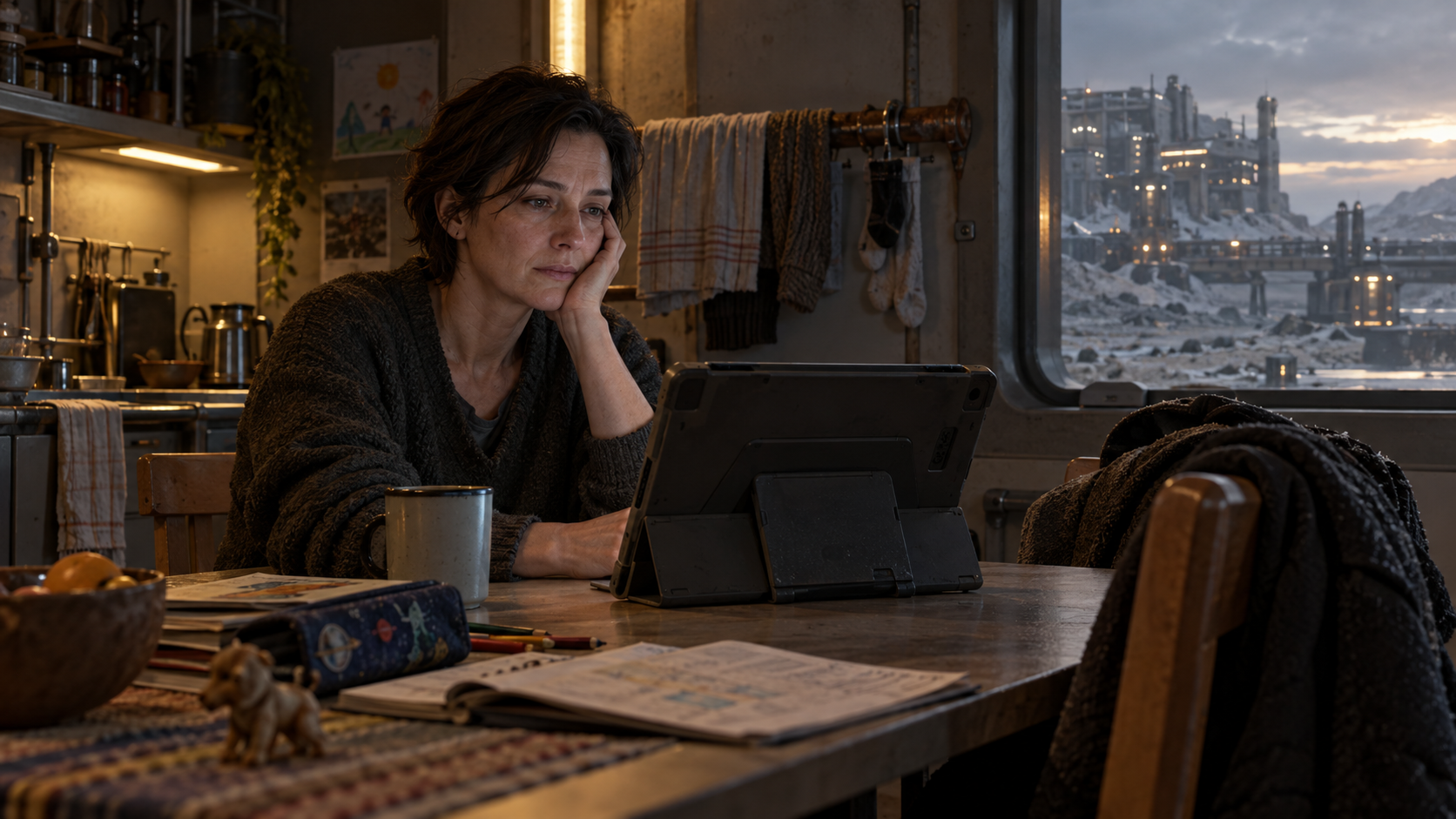
Jade had postponed opening it while she checked the names, as though an improved list might improve the answer.
Ena appeared at a kitchen table on Argos. Behind her, strips of washed fabric hung over a warm pipe. Her husband had worked the second tender.
“The school account tried to renew against his wage authorization,” she said. “I stopped it because I didn’t know whether I should. Then they told me stopping it would cost more.”
She looked down at something beside the recorder.
“I’m not asking you to call him alive. I know you can’t. I need to know what I can tell people while we wait.”
Jade paused the message before its end.
She had prepared for anger. She would have known what to do with it.
Instead she sat in the little compartment behind the bridge, with her hands resting on her knees, and worked out how long a school could keep a place open on uncertainty.
When she resumed the recording, Ena had only one more question.
“Did he have his coat? He said they were keeping the tenders cold.”
Jade went to find someone who knew.
The revised plan took two hours and was worse business than the original offer.
Jade pledged part of her own cargo share for a smaller advance. Ordinary ore would be sold first. The odd sample would remain sealed, available for an independent assay. Crew medical expenses would take priority over refitting the captain’s launch, whose docking problem she had been postponing for months.
None of it made the missing appear.
It did keep their shares open, with interim payments to their dependants recorded against the ship’s reserve instead of a final casualty settlement.
Tomas read the figures in silence.
“This doesn’t last forever.”
“No.”
“Tell them that.”
“I will.”
“And the extraction decision.”
Jade looked through the compartment window toward the bridge. Someone had taped a split glove to the repair locker so nobody would put it back in circulation by mistake.
“I’ll tell them that too.”
When the lender called, she refused the casualty revision.
The representative assured her that the proposed classification was administrative. It would have no bearing on any eventual recovery operation.
“Then leave it open,” Jade said.
“That changes our exposure.”
“Yes.”
Afterward she assembled the available crew in the mess. Nobody cheered. A medic asked when payment would clear. A deckhand asked whether a search was actually being planned. Tomas wrote down the questions she could not answer.
Jade told them which decision at the seam had been hers.
One of the survivors left before she finished.
She let him go.
Later she recorded a reply to Ena. She gave the payment date, named the person handling the account, and said plainly that she did not know whether her husband could be recovered alive.
Then she told her about the coat.
He had worn it. A tender hand remembered him complaining that the sleeves caught on the restraint buckles. He had meant to have them shortened at home.
Jade checked the recording once and sent it with the next outgoing bundle.
On the bridge, Tomas had placed the two manifests side by side. She signed the one with the blanks.