
The Long Way Home
Nolan Sinclair has a paid departure slot and no reason to linger at a worn refueling depot. Then a small shipment asks more of him than its weight suggests.

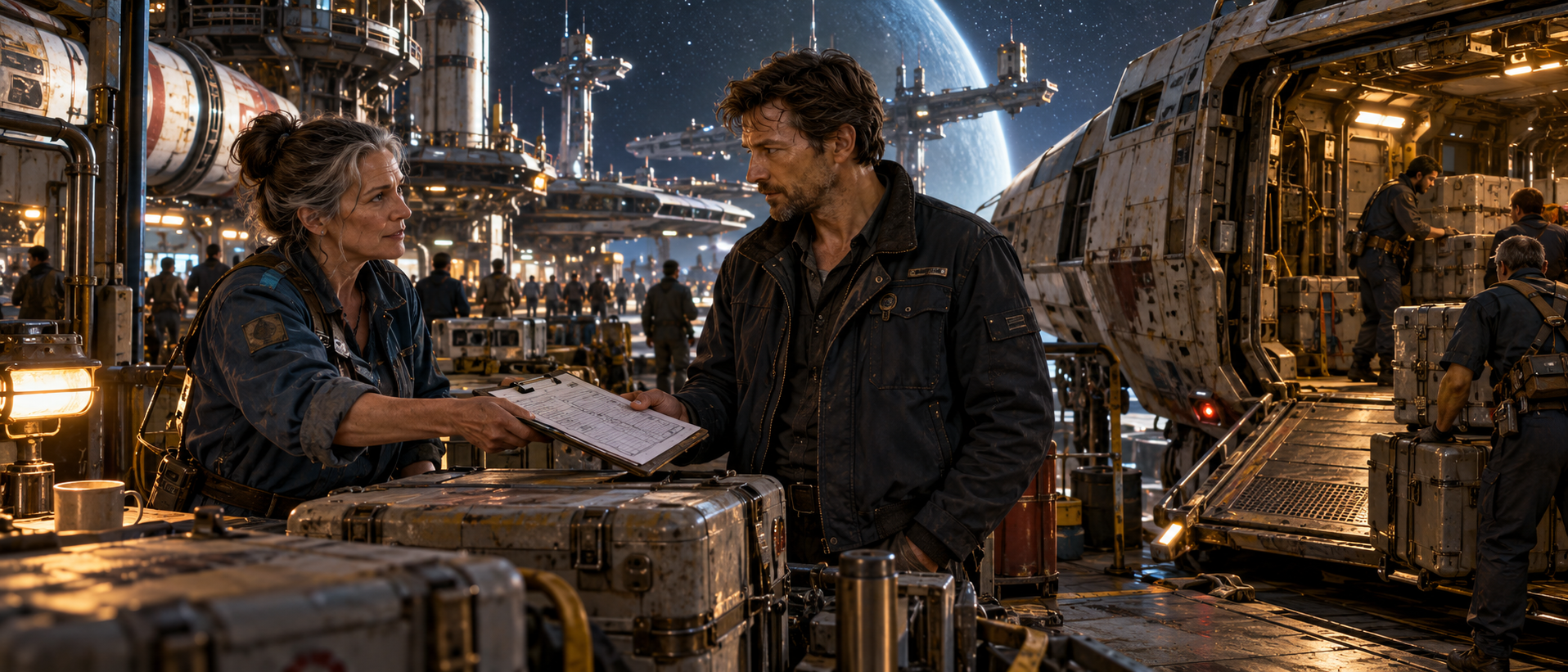
Captain’s Log: 2734 — Harrow Reach
Nolan Sinclair has a paid departure slot and no reason to linger at a worn refueling depot. Then a small shipment asks more of him than its weight suggests.
The replacement seal cost more than the berth.
Nolan turned the price display toward the dockmaster.
“For a ring of rubber.”
“Composite,” Hessa Val said.
“For a ring of composite.”
“For the right ring of composite, six weeks from the people who make it.”
Behind her, Harrow Reach vibrated with the work of pumping fuel between ships that would describe it afterward as a brief stop. A child in a blue school jacket passed the office carrying two covered bowls. Hessa took one, signed a receipt, and placed it beside her terminal.
“Lunch?” Nolan asked.
“My sister’s. Mine comes later.”
The child continued along the passage with the remaining bowl.
He paid for the seal.
Harrow Reach had grown around a fueling manifold that should have been replaced before anyone decided to raise children beside it. Successive owners had added pressure shells, repair berths, water stores, and enough promises to make departure sound temporary. The older families no longer remembered which annex their grandparents had expected to leave.
Nolan liked the place for a few hours at a time.
He was due to depart in forty minutes.
Hessa found him at the Silent Void’s open ramp, checking the new seal against the old one.
“Wrong size?”
“Right size. I’m enjoying the rarity.”
She held a small cargo authorization.
“There’s a maintenance outpost on your route.”
“Near my route.”
“Near your route,” she agreed.
He waited.
“They need valve seats and a pair of filter seals. Their reclamation system is losing capacity. They can keep rationing until the next freight tender, but the tender’s been delayed.”
“Why?”
“A medical diversion.”
There was no profitable villain in the explanation. He found that mildly inconvenient.
“How much cargo?”
“Less than the food you haven’t bought yet.”
“How much time?”
“An extra approach. Docking. You’ll miss this departure sequence.”
“And the contract waiting at the other end.”
“I know.”
Hessa did not tell him the people at the outpost were children. She did not promise him a statue. She held the authorization with the practiced patience of someone who had asked several captains already.
Nolan pictured the route. He could carry the cargo, lose the departure slot, and ask his client for a revised window. The client would decline. Someone else would take the job.
He looked past Hessa at a strip of tape on the dock rail. Beneath it, an older berth number showed through the paint.
“How much are they offering?”
“Fuel difference and docking waiver.”
“So I pay for my better nature.”
“You can put that on the receipt if it helps.”
He took the shipment aboard and spent ten minutes being unpleasant to nobody.
The client canceled exactly as expected. Harrow Reach moved his departure slot to a less convenient window. His stores order arrived with a substitution he did not want.
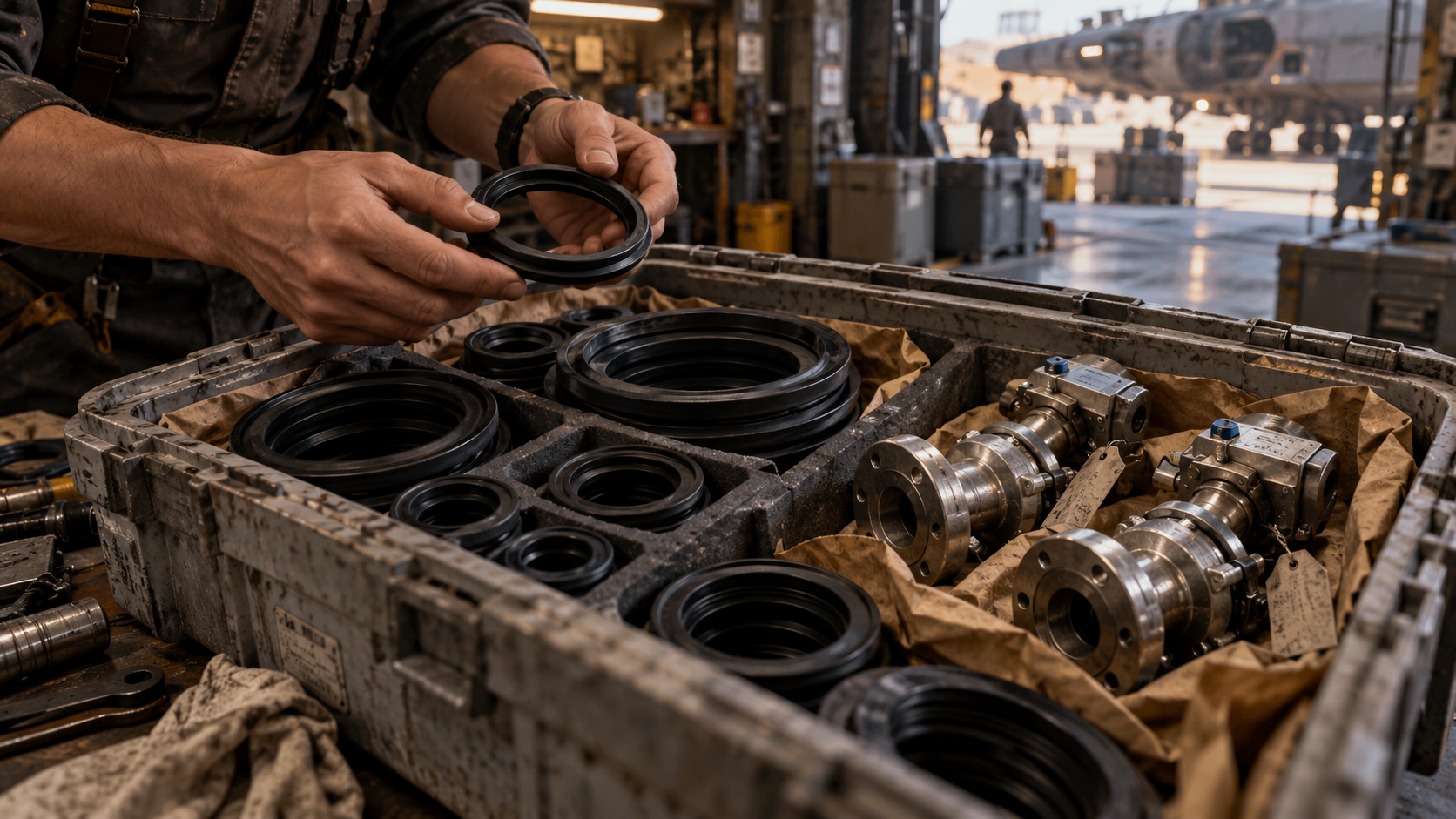
He stowed the valve seats in a cabinet beside the pressure equipment, fastening the straps himself. They were ordinary things. Black rings, machined metal, protective wrapping. He had traveled past extraordinary sights without stopping; now a box of seals had changed his route.
An incoming relay bundle arrived before he closed the hatch.
Maris.
He opened the message expecting something about the house.
She sat at her work desk with one sleeve pushed above the wrist. People moved beyond her shoulder. She waited for someone to finish speaking nearby before she began.
“I need a practical answer, Nolan. When a ship records a received broadcast, is it necessarily recording the sound that comes out of its speakers?”
She described an interruption at a station during the Deep Blink. Seven sounds. A public recording that omitted them. A disconnected panel that had lit up.
Then she held up a hand, anticipating him across the distance.
“I’m not asking you to break into anything. I’m asking what a recording can miss.”
The message ended.
He played it again.
Nolan’s first reply was too long.
He explained feed paths, local injection, buffers, clock drift, relay packaging, and the ways a cheap amplifier could make a respectable log dishonest without altering a byte. Halfway through, he heard himself becoming the person Maris had raised a hand against.
He deleted it.
From the cockpit, he could see Hessa arguing with a freight captain through the office window. The child in the school jacket had returned. This time there were three bowls.
Nolan recorded a shorter answer.
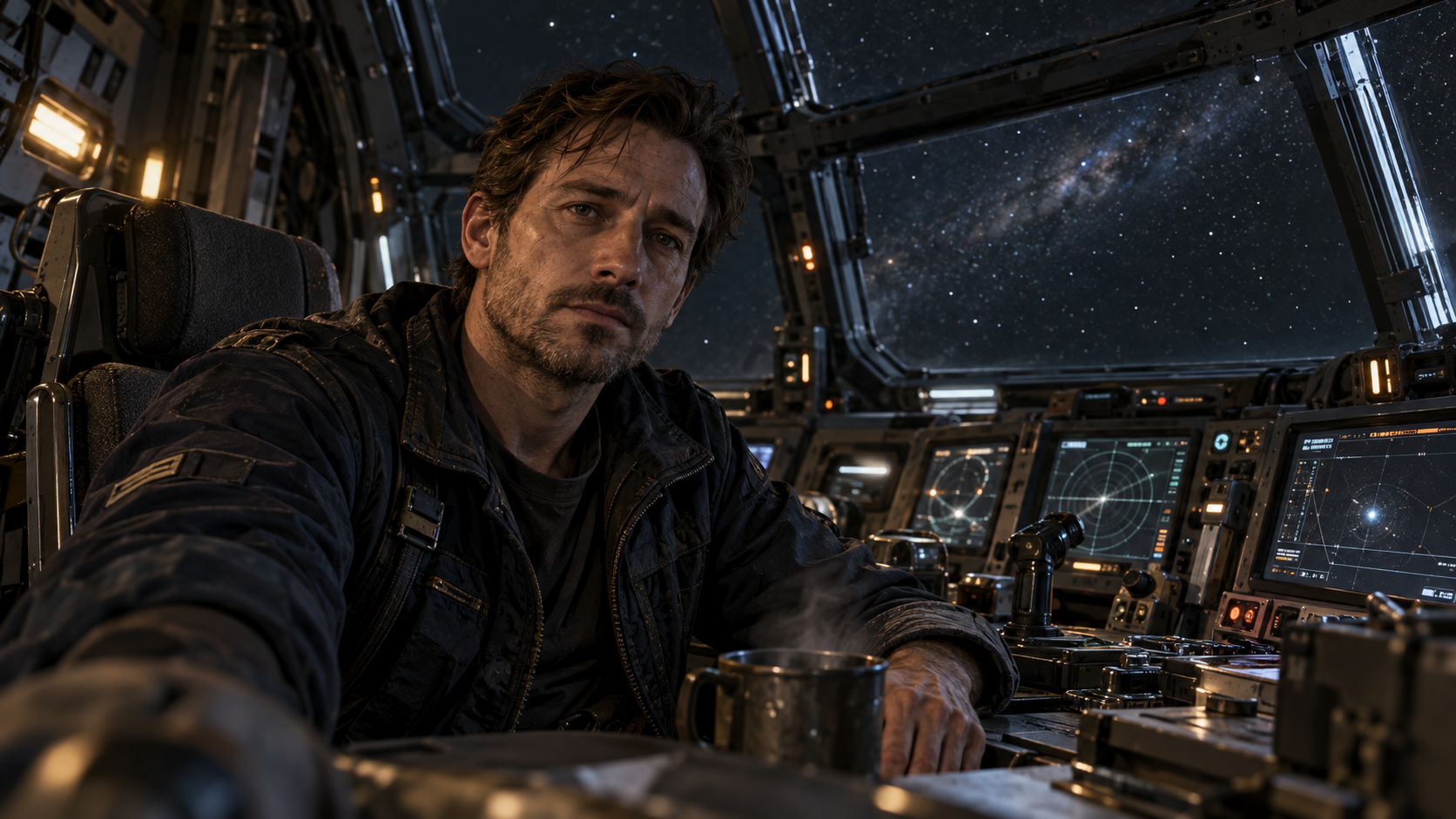
“No. The feed recording and the sound in the room can differ. It doesn’t tell you why. Keep the local equipment records if you can. And don’t let somebody make a clean export over your only copy.”
He paused.
“If you send the times with the time standard attached, I can compare what my receiver kept. I wasn’t in the same system. That matters.”
Another pause, longer this time.
“Are you all right?”
He nearly removed the question because it sounded inadequate after the technical advice.
Instead he sent the message.
The maintenance outpost had two docking arms and a third that existed only in its planning documents.
Nolan arrived later than he would have reached the paying job. A tired technician accepted the crate, checked the sizes, and closed her eyes briefly when they matched.
“Thank you.”
“It’s the glamorous work,” he said.
She laughed because she was relieved, not because the joke deserved it.
While she fitted the replacements, Nolan waited in a galley that smelled of boiled grain. A board above the sink assigned water allowances by shift. Someone had drawn a small boat beside the largest number, then crossed it out.
He was offered a meal. He accepted.
Nobody asked where he had been before Harrow Reach. Nobody knew about Aletheion, or the container he had carried, or the hundreds of places he could describe more easily than his own home.
A pipe shuddered behind the wall. The galley tap produced a brief brown sputter, then a clear stream. The cook let it run into a measuring jug until a sensor approved the water.
A few people clapped. Most went back to eating.
Nolan stayed for another cup.
Maris’s answer reached him through the outpost relay while the Silent Void was still coupled to the docking arm.
I’m all right. Keep whatever you have. No need to make a detour for this.
Below it was a second message.
Did you ever replace that seal?
He looked toward the cabinet, where the old ring lay waiting to be discarded.
Yes, he wrote. Paid enough for it to deserve its own cabin.
Then he opened the navigation display and entered Argos as a later stop, after the obligations he could still fulfill.
He did not send her the route. She had received enough promises from people who were always about to be somewhere else.
Instead he saved the receiver archive, checked its retention settings, and set a reminder to call her when he next had a stable connection.
The departure light turned green.
For once, he finished the cup before he went.