
Seven Rows
Stranded in a dark nebula, Saul McGrail has found a garden where no garden should be. He still needs enough fuel to leave it.

Captain’s Log: 2734 — Sector Mira
Stranded in a dark nebula, Saul McGrail has found a garden where no garden should be. He still needs enough fuel to leave it.
Saul had given the discovery three names before he found the edge of its enclosure.
The first had sounded magnificent. The second would look better on a chart. The third was an expression he used when his boot caught a nearly invisible retaining lip and sent him sprawling across the rock.
His tether arrested the fall.
He lay still, breathing too quickly, while the suit waited for him to stop being embarrassed.
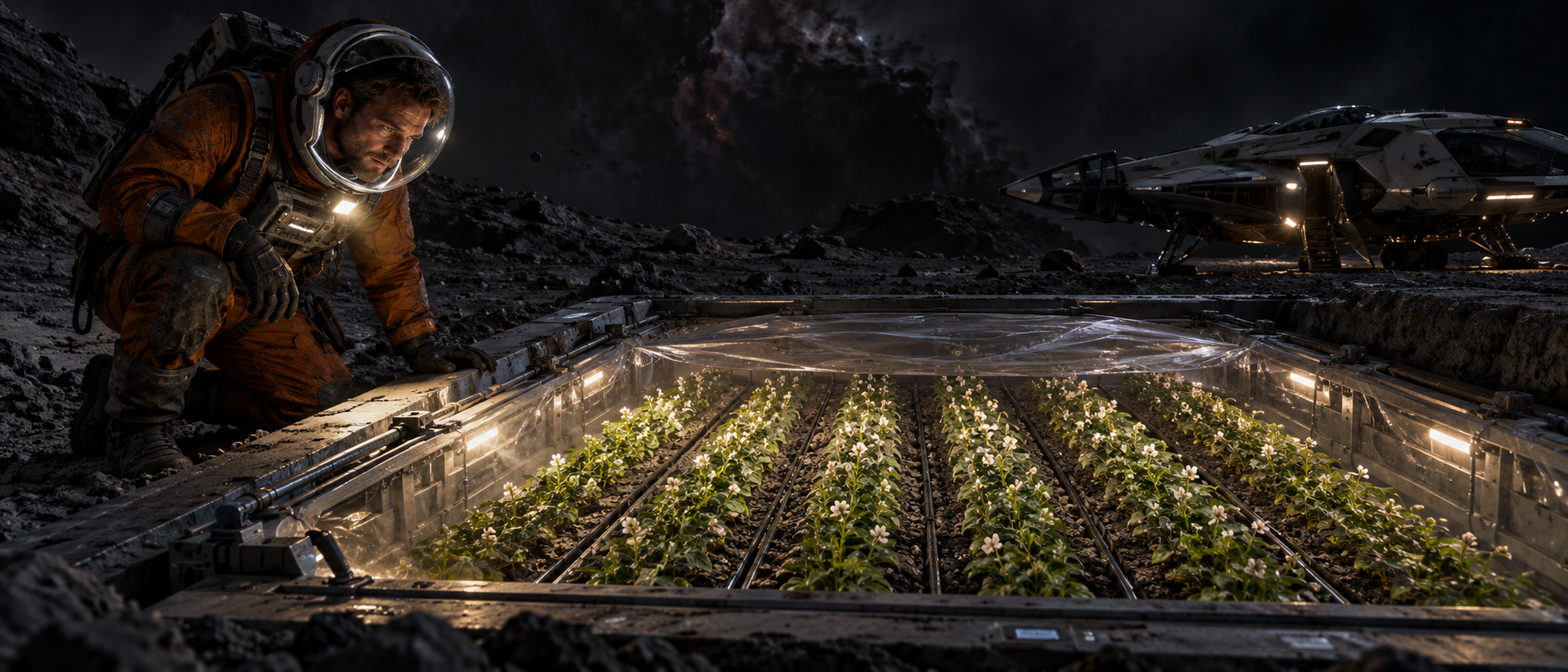
Above the plants, the beam of his lamp caught a faint sheen. A flexible transparent membrane lay low over the growing bed, following its shallow contours so closely that he had mistaken it for darkness. Fine grains of frost clung to its outer edge.
There was pressure beneath it. Warmth too, according to his wrist sensor.
“Very clever,” he said.
Nobody replied.
Seven straight rows of plants stood within the bed. Small pale flowers. Narrow leaves. Stems that curved away from the lamp without any movement he could actually see.
He recorded the scene again, omitting the fall.
Then he checked the Traveler’s reserves.
The figures were unchanged. Its caretaker display had found a less tactful way of presenting them.
Saul knew enough about plants to recognize that eating one would not get his ship home.
He also knew that a garden required things to arrive and things to leave. Heat, water, nutrients, waste. Someone who had brought all of those to an asteroid might have left something useful in a pipe.
He walked the bed’s perimeter.
The enclosure occupied a shallow cut in the rock. Beneath one corner, a pair of narrow hoses disappeared under a maintenance cover. He brushed dust from the fasteners and found that one had been replaced with a different size.
He smiled behind the visor.
A repair. He understood repairs.
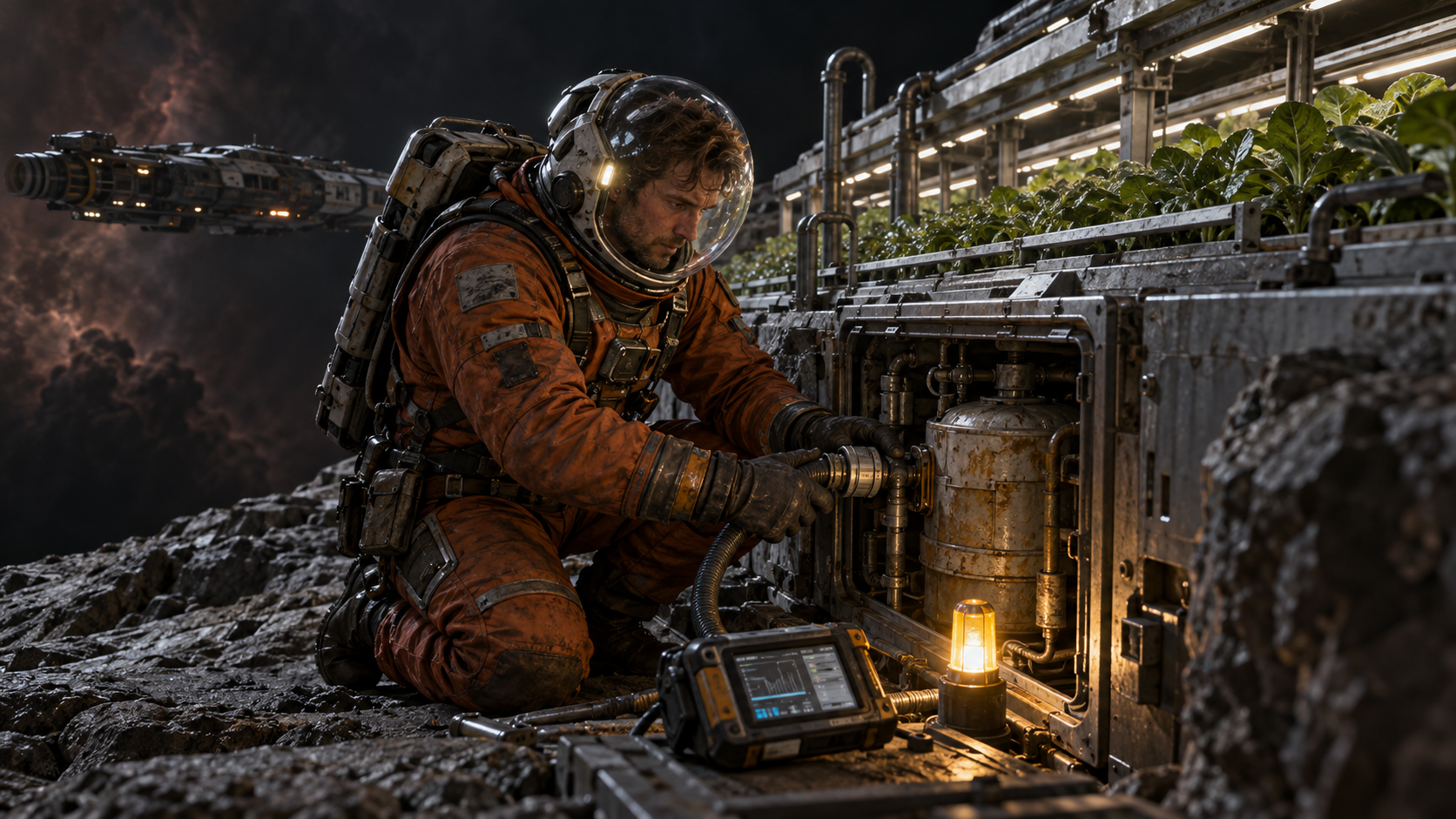
The cover resisted him, then lifted with a small release of frost. Below it sat a heat exchanger, a compact circulation unit, and a reservoir with a manual sampling port. The machinery had the awkward arrangement of something designed to fit an available space rather than a pleasing picture.
One hose wore three clamps, each of a different pattern.
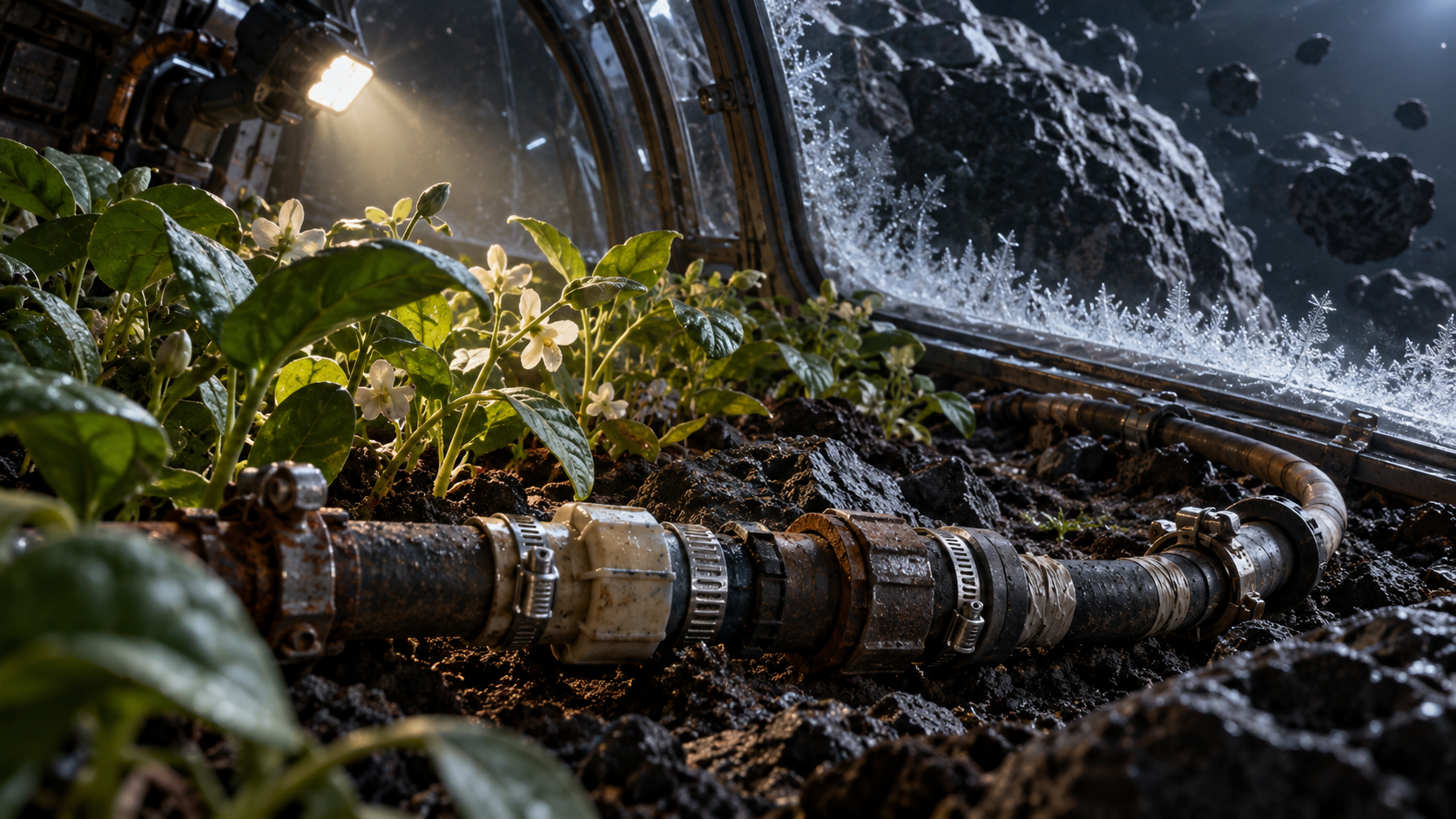
Saul photographed those too.
He considered addressing whoever maintained the garden. His transmitter had failed to reach even the nearest relay through the nebula. There might still be a local receiver.
“Saul McGrail,” he announced on a short-range channel. “I’m experiencing an inconvenience.”
The suit gave him only his own voice.
“I would like to purchase a small quantity of anything combustible.”
Nothing.
“Or borrow it.”
He waited a little longer.
The sampler returned water, trace nutrients, and an organic process fluid in a separate circuit.
That last result encouraged him more than it should have. He ran the test again using the Traveler’s kit, brought out on a tethered cart. Then he submitted both readings to the auxiliary reformer.
The reformer could accept the fluid after filtering.
At poor efficiency.
With a shortened service interval.
Under operating conditions that filled two screens.
“Keep some objections for the return journey,” Saul told it.
He did the arithmetic himself. Not enough for a proper transit. Enough for a low-power crawl toward the mapped thinning of the nebula, if he shut down several comforts he considered essential. From there he might reach a rescue relay.
Might was an improvement.
He calculated how much fluid the garden could spare. The reservoir’s level marks were legible even though its printed label had worn away. He could take enough for a better margin by draining below the lower line.
He looked back at the plants.
There were no footprints except his. No hut. No discarded cup. The unknown gardener had not left a convenient explanation of how frequently they returned.
Saul removed a hose from his transfer kit and connected it to the service outlet.
He stopped at the lower line.
The ship objected to the available quantity.
“Yes,” he said. “We’ve covered that.”
Filtering took longer than the garden’s discovery.
He sat in the Traveler’s cockpit with the cabin heat reduced and watched a thin amber line advance through the processing display. The view beyond the glass was almost entirely black. His work lamps picked out the corner of the cultivation bed, its seven rows reduced to pale strokes under the membrane.
He tried composing the account he would give on Argos.
The crowd would enjoy the impossible garden. They would enjoy his escape. Somewhere between the two he would have to place a heroic decision, preferably one involving less sitting in the cold.
The transfer pump clicked off.
He checked the filter. A deposit coated its mesh. He bagged a sample, labeled it, and stopped himself from giving the substance a name.
Outside, the disconnected service cover lay where he had dropped it.
He looked at the time remaining on his suit charge. Then he put the helmet back on.
The smaller fastener went in badly.
Saul backed it out, realigned the cover, and tried again. With his gloves on he could not feel the thread catch, only see the slight movement of the plate. It took three attempts.
As he worked, his lamp moved across the hose clamps. One was stamped metal, another woven composite. The third looked as though it had been cut from a larger fitting and filed down by hand.
Whoever had maintained this place had not always had the right parts.
That made the garden more familiar, and somehow stranger.
He checked the enclosure for leaks. No change in the pressure reading. At the far end, a detached tendril had caught inside a service channel. He took a tiny loose fragment with sterile tweezers and sealed it in the sample tube, leaving the growing stems alone.
Before he returned to the ship, he secured a plain marker beside the reservoir: his identity, the volume taken, the scan of the fluid, and an offer to settle the debt at any reachable port.
He entered an account he actually used.
Then he photographed the marker and the restored cover. Neither image would interest a crowd.
The Traveler lifted reluctantly.
Saul kept the burn gentle. A little more fuel would have made him feel much better; the remaining fluid on the asteroid occupied his thoughts for the first hour.
During the second, he forgot to resent it.
The first faint relay carrier appeared while he was eating an unheated ration. It vanished before he could send. He kept moving along the survey line, watching the reserve decline.
When it returned, he transmitted a distress packet without adding a description of the garden.
Name. Ship. Position. Remaining reserves. Assistance required.
He disliked how small it made the journey sound.
The packet received an acknowledgment from an automated buoy. A rescue request had entered the queue. No vessel assignment yet.
Saul lowered his seat and let himself breathe.
In the sample locker behind him, a fragment of leaf rested inside a sealed tube. He could not tell whether it was still alive.
He opened his private log and began with the mistake.
I should have checked the exit reserve before making the hop.
For a while he left the sentence alone on the screen.
Then he added the coordinates of the garden.