
A Door on Paper
The service panel Maris Sinclair saw wake during the Deep Blink is officially disconnected. Finding out who owns the door proves more difficult than finding out where it goes.

Captain’s Log: 2734 — Argos
The service panel Maris Sinclair saw wake during the Deep Blink is officially disconnected. Finding out who owns the door proves more difficult than finding out where it goes.
The maintenance office sent Maris to Transit. Transit sent her to Municipal Structures. Municipal Structures returned the request because the number in her photograph belonged to a retired asset.
She amended the request to say that the retired asset was illuminated.
The response arrived nine minutes later.
Please report electrical faults through Maintenance.
Maris set the terminal facedown on her desk.
Across the room, a colleague was explaining to an angry man why she could not issue a permit in a name he refused to provide. The morning smelled of hot wiring and the soup somebody had brought in a badly sealed container.
Two days had passed since the Deep Blink. She had slept poorly on both nights.
She picked up the terminal and called Oren Pell.
“Do you still have access to the old transit plans?”
“Good morning to you too.”
“Good morning. Do you?”
“Depends how old.”
“Before anyone currently employed decided what to call them.”
“Bring lunch.”
The archive occupied a former freight exchange beneath a civic building whose foundation works had never been fully reconciled with the exchange beneath it. Rainwater from a surface leak had once traveled six levels to destroy a shelf of flood surveys. Oren referred to this as the building’s only successful cross-departmental project.
He met her at the inner gate with a scanner in one hand and a spoon in the other.
“What happened to the seal?” he asked.
For a moment she thought he meant the door.
“In your shuttle. You said it was leaking.”
“Still leaking.”
“You live dangerously.”
“I brought bread.”
He admitted her.
Maris showed him the photograph. He enlarged the panel, then the hinge label, then a strip of damaged tile she had barely noticed.
“That number’s been reused,” he said.
“How many times?”
“Enough that somebody should have stopped.”
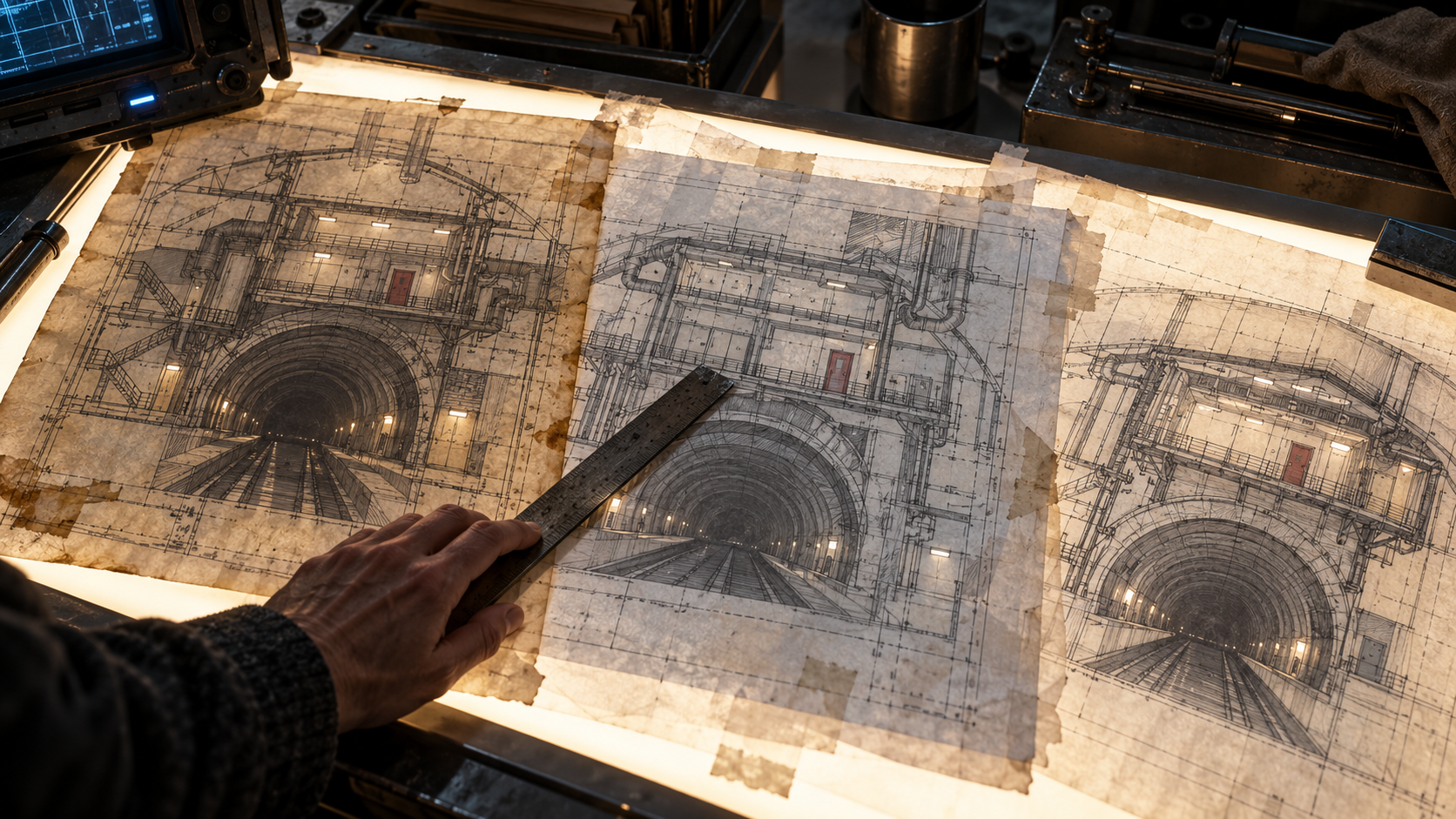
The current plan showed a shallow utility recess. The previous plan showed a blank space. An older structural survey marked a passage curving behind the platform before descending into the housing levels.
Oren laid the layers over each other. Three confident drawings disagreed in three different ways.
“Which is right?” Maris asked.
“For what purpose?”
“For walking through.”
“Then I’d want someone with a lamp to answer.”
He moved to a cabinet and began unlocking drawers.
The oldest plans were not originals. Generations of archivists had copied them from media that had failed, become unreadable, or required machinery someone had sold. Handwritten cautions followed the drawings from format to format. Some survived as illustrations of handwriting nobody could decipher.
Oren found a cross-section with a sequence of doors drawn in thick red lines.
“Refuge passage,” he said.
Maris leaned closer.
Behind the service door lay a route connecting two old residential terraces to a protected transit chamber. The associated notes described air reserves, water taps, and a hand-operated gate.
“Why was it closed?”
“Maybe it wasn’t.”
“It’s on the abandoned list.”
“The panel is. The passage is on another list.”
He looked at her until she understood.
The distinction had begun with a maintenance transfer.
A replacement controller received a new service contract. The old controller was retired in the asset ledger. A later digitization linked the retired controller to the door. A subsequent map export omitted retired doors.
The rooms behind it still existed. Their connection to the refuge route had disappeared.
Nobody had needed to conceal anything. Each person had completed the task assigned to them.
Maris rubbed her eyes.
“There are occupied addresses down there.”
“There usually are.”
“How many?”
Oren gave her the residential reference numbers.
One belonged to the building named on the eviction hold she had entered before the Deep Blink.
She checked it twice. It was not the woman's apartment alone; it was the whole terrace, forty-seven dwellings arranged around an old ventilation shaft. The map problem had turned their emergency access into a maintenance exception. That exception had helped justify a rising safety charge, now folded into the disputed leases.
Maris thought of the death certificate, held carefully in both the woman's hands.
“Can I have a certified copy?”
“You can have three. One for whichever office loses the first two.”
They visited the terrace before she returned to work.
Oren came because the plans specified a reference mark he wanted to see. Maris suspected he also wanted to leave the archive while there was an excuse.
The walkway was narrow and warm. Pots of kitchen herbs stood beneath supplemented lamps. Someone had painted a line along a wall to mark how far children could play without supervision; later hands had extended it around a repaired drain.
The woman from the housing counter opened her door with a dishcloth over one shoulder.
“Did the hold fail?”
“No,” Maris said quickly. “It’s still in place.”
She explained about the refuge passage.
The woman frowned.
“The winter door?”
“Is that what you call it?”
“My mother called it that.”
She took them past a laundry room to an alcove partly occupied by folding chairs. At the back was a steel door, painted repeatedly, with a handwheel whose rim had polished bright through use.
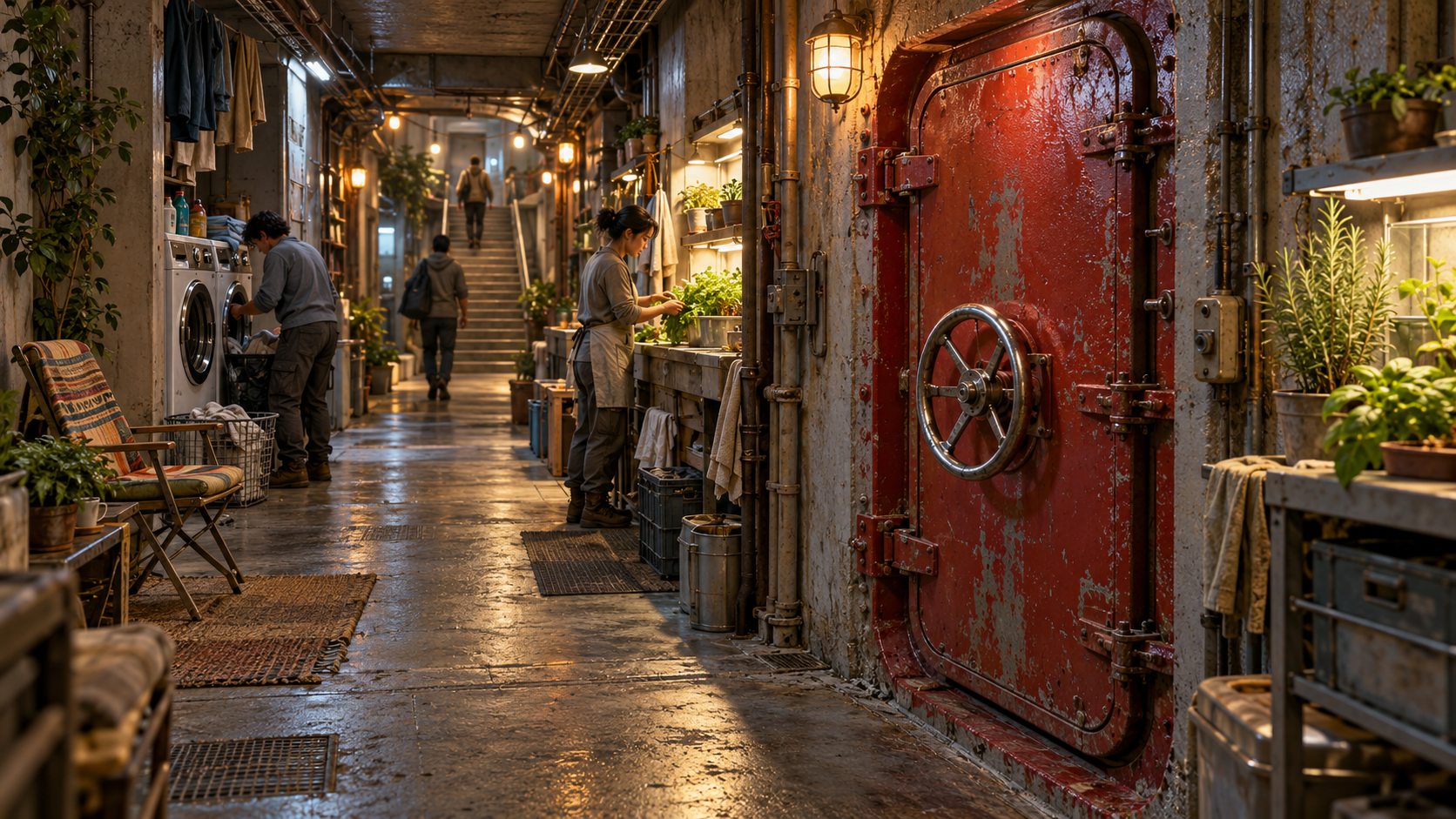
Oren compared its lintel to the drawing.
“Correct elevation,” he said.
The woman moved two chairs aside.
“They said we weren’t to use it. Years ago. Someone came around with notices.”
“Because it was unsafe?”
“Because it wasn’t ours.”
Maris looked at the handwheel. There was no reader beside it, no place to submit a credential. Whoever had designed it had expected a frightened person to arrive without the proper documents.
From the other side came a faint sound of ventilation.
“Does somebody maintain it?”
“The taps get checked.”
“By whom?”
“A man in overalls. Different man before him.”
She shrugged, apologetic for the inadequacy of an answer that kept water in the taps.
Back at her desk, Maris split the investigation in two.
One file concerned access rights, occupancy, and the fact that people depended on a route their records failed to acknowledge. That problem could be addressed with plans, inspections, and signatures.
The other contained the seven sounds, the illuminated panel, and the movement behind the station door. Oren’s documents explained none of those.
She had wanted them to.
A history of neglect was both easier to prove and harder to enjoy than the thing her sleepless mind had been assembling.
She wrote the access request first. She attached the certified plan, the existing maintenance entries, and the terrace addresses. A qualified inspector would have to test the route before anyone told residents they could depend on it again.
Only then did she open the second file.
Oren had sent one more drawing. It showed a local event recorder inside the passage, connected to the old door mechanism. Its maintenance specification called for a physical recording strip, retained during loss of network connection.
She stared at the drawing.
It might have been removed decades earlier. It might never have worked. The strip, if one remained, could show nothing beyond ordinary pressure changes.
She added it to the inspection request anyway.
Her terminal chimed with a housing inquiry. The woman wanted to know whether she should throw away the first receipt now that there was a new case number.
Maris answered immediately.
Keep both.